
Table of Contents
Introduction
A skid steer loader is built for job sites where space is limited, work changes quickly, and one machine needs to handle more than one task.
For contractors, landscapers, farm operators, and municipal teams, this type of compact loader offers a practical mix of maneuverability, attachment flexibility, and everyday productivity.
For Luyue Machinery, skid steer loaders fit naturally beside mini tracked excavators, remote control lawn mowers, and excavator accessories as part of a compact equipment lineup for global buyers.
Why Skid Steer Loaders Fit Modern Job Sites
Modern job sites rarely involve one simple task from start to finish.
A contractor may need to prepare ground in the morning, move materials after delivery, clean the site before inspection, and switch to grading work later in the day.
This is where a skid steer loader becomes useful.
Its compact body allows it to work in areas where larger loaders are difficult to position. Its quick-attach system also allows operators to change tools according to the job instead of relying on several separate machines.
Compact Size for Restricted Work Areas
One of the strongest advantages of a skid steer loader is its ability to work in tight spaces.
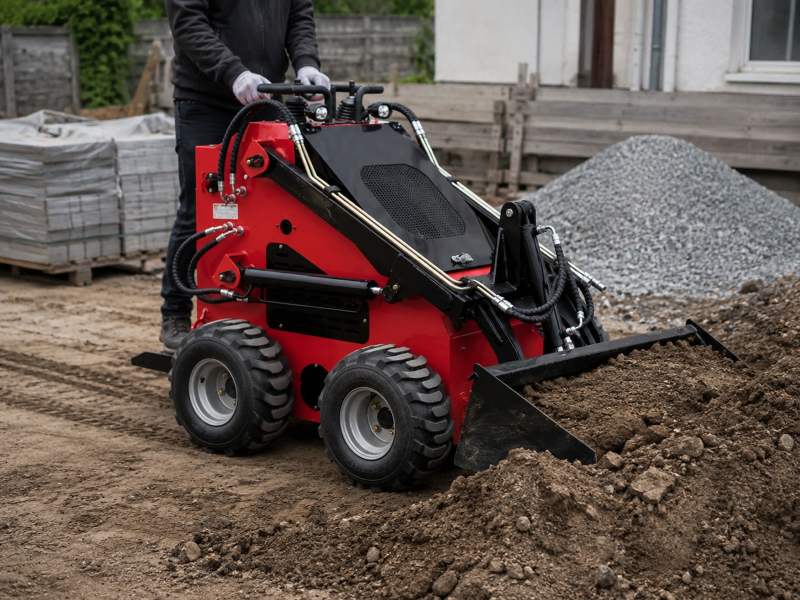
On urban construction sites, space is often limited by buildings, walls, fences, parked vehicles, or stored materials. A compact loader can move through narrow access points and turn efficiently in confined working zones.
This makes it suitable for:
| Job Site Type | Why a Skid Steer Loader Works Well |
|---|---|
| Urban construction | Compact movement in restricted spaces |
| Residential projects | Less space required for operation |
| Landscaping sites | Easier access through narrow areas |
| Municipal work | Efficient movement near roads and public areas |
| Agricultural facilities | Flexible operation around buildings and storage zones |
Instead of simply being a small machine, a skid steer loader is valuable because it can stay productive where larger equipment becomes inconvenient.
Construction Applications for Skid Steer Loaders
In construction, skid steer loaders are often used throughout different stages of a project.
During early site preparation, they help move loose material, support grading work, and keep the working area organized. As the project continues, the same machine can assist with loading, cleanup, and attachment-based tasks.
This makes the skid steer loader especially useful for small and medium construction projects where efficiency depends on fast task switching.
Site Preparation with Better Control
Before foundation work, paving, or installation begins, the ground usually needs to be cleaned, shaped, or leveled.
A skid steer loader can help prepare the site by moving soil, spreading aggregate, and smoothing uneven areas. With the right attachment, operators can achieve more consistent surface preparation while reducing manual labor.
For contractors working on residential or commercial projects, this type of machine helps improve workflow without taking up excessive space.
Material Handling on Active Job Sites
Material handling is one of the most common reasons contractors use skid steer loaders.
Construction sites often require constant movement of sand, gravel, soil, debris, and packaged materials. A compact loader allows operators to move these materials efficiently between storage areas, working zones, and loading points.
Compared with manual handling, this improves productivity and helps keep the job site cleaner and safer.
Landscaping Applications with Less Site Disturbance
Landscaping work requires more than power. It also requires control.
A machine used for landscaping must operate around lawns, pathways, trees, fences, and finished surfaces. Skid steer loaders are well suited for this type of environment because they combine compact movement with useful lifting and grading ability.
For landscape contractors, the main value is not just moving material faster. It is the ability to complete different stages of the project with one adaptable machine.
Preparing Ground for Outdoor Projects
In landscape contracting, ground preparation often determines the quality of the final result.
A skid steer loader can help shape soil, distribute base material, prepare garden areas, and support surface leveling before paving, planting, or drainage work begins.
When equipped with grading tools, the machine can create more consistent surfaces and reduce the amount of hand finishing required.
Handling Soil, Stone, and Landscaping Materials
Landscaping projects often involve materials that are heavy, loose, or difficult to move manually.
A skid steer loader can handle soil, mulch, stone, gravel, and debris efficiently. This is especially useful on commercial landscaping sites, garden construction projects, and property development work where materials need to be moved repeatedly across the site.
The result is a smoother workflow and better use of labor.
Agricultural Applications Beyond Basic Farm Work
In agricultural operations, equipment must adapt to changing seasonal needs.
A skid steer loader can support farm maintenance, material movement, and property management in a compact machine format. Its size allows it to operate around barns, sheds, storage yards, and service paths where larger equipment may be less practical.
For farms with mixed daily tasks, this flexibility is highly valuable.
Working Around Farm Buildings and Storage Areas
Agricultural spaces often include narrow lanes, covered storage areas, and uneven service roads.
A skid steer loader can move through these areas more easily than larger loaders. It can help maintain working zones, transport bulk materials, and support routine site upkeep without requiring wide turning space.
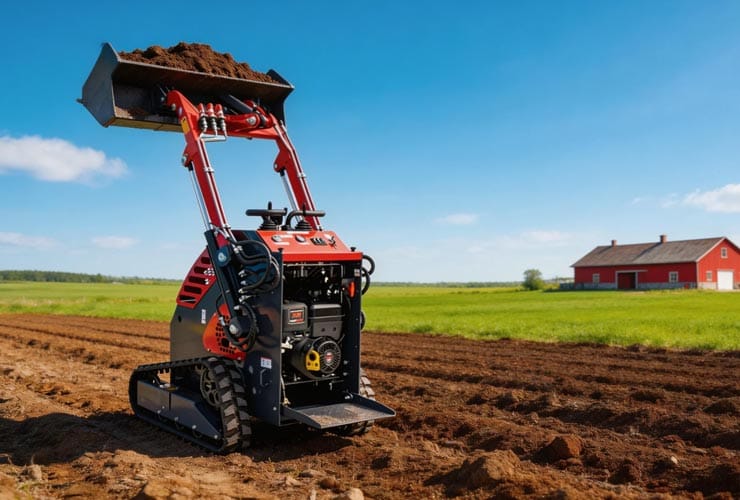
Tracked skid steer loaders are especially useful where ground conditions are soft, muddy, or uneven.
Why Tracks Matter in Agricultural Conditions
Ground conditions on farms can change quickly after rain, irrigation, or seasonal use.
A tracked skid steer loader provides better traction and stability than a wheeled model in many soft-ground environments. The track system spreads weight more evenly, helping reduce excessive ground pressure while improving control.
This makes tracked models a strong option for agricultural users who need dependable movement across less predictable terrain.
Municipal Maintenance and Public Works
Municipal teams often need compact machines that can work efficiently in public areas without creating excessive disruption.
Skid steer loaders are useful for road maintenance, public space cleanup, snow management, and drainage-related work. Their compact design allows operators to work near sidewalks, roads, parks, and public facilities where larger machines may be too intrusive.
This makes them practical for year-round maintenance programs.
Roadside and Urban Maintenance
In municipal work, access and maneuverability are often just as important as machine power.
A skid steer loader can operate near curbs, road edges, parking areas, and pedestrian zones. With attachments such as sweepers, buckets, and blades, the machine can support different maintenance needs across the year.
For city service teams, this helps improve response speed and equipment utilization.
Attachment Flexibility That Expands Machine Value
A skid steer loader becomes much more valuable when paired with the right attachments.
Instead of buying a machine for one function, operators can use it as a compact power unit for different tasks.
| Attachment | Practical Use |
|---|---|
| Bucket | Loading, carrying, and spreading loose materials |
| Grapple | Handling brush, debris, and irregular materials |
| Auger | Drilling holes for posts, trees, and foundations |
| Pallet Fork | Moving packaged materials and supplies |
| Grading Tool | Leveling and surface preparation |
| Sweeper | Cleaning roads, yards, and paved areas |
This attachment flexibility is one reason skid steer loaders are widely used by contractors, farms, and municipal teams.
Wheeled or Tracked Skid Steer Loader?
Choosing between a wheeled and tracked skid steer loader depends on the working surface.
A wheeled model is usually more efficient on hard, stable ground. It moves quickly and performs well on paved or compacted surfaces.
A tracked model is better suited for soft soil, uneven ground, landscaping work, and muddy conditions. It provides stronger traction and better flotation where wheels may lose grip.
| Machine Type | Best For | Main Advantage |
|---|---|---|
| Wheeled skid steer loader | Paved surfaces and stable ground | Faster travel and lower surface resistance |
| Tracked skid steer loader | Soft soil, slopes, rough terrain | Better traction and stability |
For buyers, the right choice depends on where the machine will be used most often.
How to Choose the Right Skid Steer Loader
A good skid steer loader should match the buyer’s real working conditions.
Before choosing a model, it is important to consider job site space, ground conditions, attachment needs, lifting requirements, and expected daily workload.
A machine that is too large may lose the compact advantage. A machine that is too small may struggle with heavier tasks. The best choice is usually the one that balances size, power, control, and attachment compatibility.
Where Luyue Skid Steer Loaders Fit
Luyue Machinery positions skid steer loaders as part of a compact equipment lineup for construction, landscaping, agriculture, and municipal applications. The website highlights skid steer loaders alongside mini tracked excavators, remote control lawn mowers, and excavator accessories, which supports a practical equipment ecosystem for buyers looking for flexible job site machinery.
For dealers and contractors, this combination is useful because these machines can serve related but different needs. A mini tracked excavator handles digging and trenching. A skid steer loader supports loading, grading, and material movement. A remote control lawn mower covers vegetation management on slopes and complex terrain.
Together, these product categories can cover many compact equipment applications from one supplier.
Conclusion
A skid steer loader is valuable because it combines compact movement, attachment flexibility, and reliable job site productivity.
Key points:
- It works well in restricted spaces
- It supports construction, landscaping, agricultural, and municipal tasks
- Attachments make it useful across multiple applications
- Wheeled and tracked models suit different ground conditions
- It pairs well with mini excavators and other compact machinery
For buyers looking for adaptable equipment, a skid steer loader remains one of the most practical compact machines for daily work.
FAQ
What is a skid steer loader mainly used for?
A skid steer loader is mainly used for material handling, grading, loading, site cleanup, and attachment-based work in construction, landscaping, agriculture, and municipal maintenance.
Is a tracked skid steer loader better than a wheeled model?
It depends on the ground conditions. Tracked models are better for soft, muddy, or uneven terrain, while wheeled models are more efficient on hard and stable surfaces.
Can a skid steer loader work in tight spaces?
Yes. Compact size and skid steering allow the machine to work efficiently in narrow or restricted job sites.
What attachments are commonly used with skid steer loaders?
Common attachments include buckets, grapples, augers, pallet forks, grading tools, sweepers, and snow blades.
Is a skid steer loader suitable for landscaping work?
Yes. It is widely used for ground preparation, material movement, grading, and property development tasks in landscaping projects.