
Table of Contents
Introduction
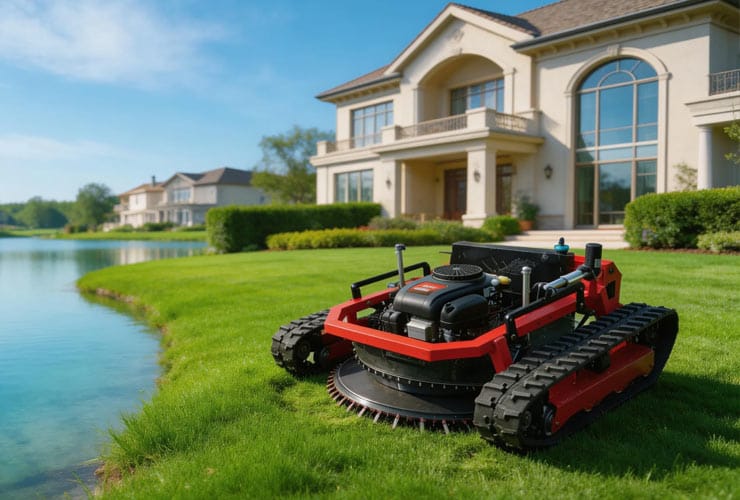
A remote control lawn mower is designed for mowing environments where safety, terrain stability, and cutting efficiency matter more than simple lawn maintenance.
Unlike standard walk-behind or ride-on mowers, this machine allows operators to control mowing work from a safe distance. It is especially suitable for steep slopes, roadside embankments, solar farms, agricultural land, and rough terrain where traditional equipment may face safety or access limitations.
Key advantages include:
- Safer operation on slopes and uneven ground
- Better traction in complex terrain
- Reduced operator exposure to hazards
- Efficient cutting for dense grass and brush
- Strong adaptability for professional maintenance work
For contractors, municipal teams, farm operators, and land maintenance companies, a remote control lawn mower provides a practical solution for areas that are difficult, risky, or inefficient to maintain manually.
Why Remote Control Lawn Mowers Are Used in Professional Terrain Maintenance
Professional mowing work is not always performed on flat, open land.
Many maintenance projects involve steep inclines, loose soil, roadside hazards, drainage channels, or overgrown vegetation. In these environments, conventional mowing equipment can become difficult to control.
A remote control lawn mower solves this problem by separating the operator from the machine. The operator can stand at a safer location while controlling direction, speed, and cutting performance.
This is why remote-controlled mowing equipment is increasingly used in:
| Application Area | Main Requirement | Equipment Advantage |
|---|---|---|
| Roadside slopes | Safety near traffic | Remote operation reduces risk |
| Solar farms | Narrow working space | Compact movement between rows |
| Agricultural land | Uneven terrain | Better traction and stability |
| Riverbanks | Sloped ground | Safer vegetation control |
| Forestry edges | Dense vegetation | Stronger cutting capability |
This makes the machine more than a lawn mower. It becomes a specialized terrain maintenance solution.
Slope Mowing Applications
Slope mowing is one of the most important uses of a remote control lawn mower.
Steep terrain creates two major challenges: machine stability and operator safety. Ride-on mowers may carry rollover risks, while manual trimming on slopes is labor-intensive and inefficient.
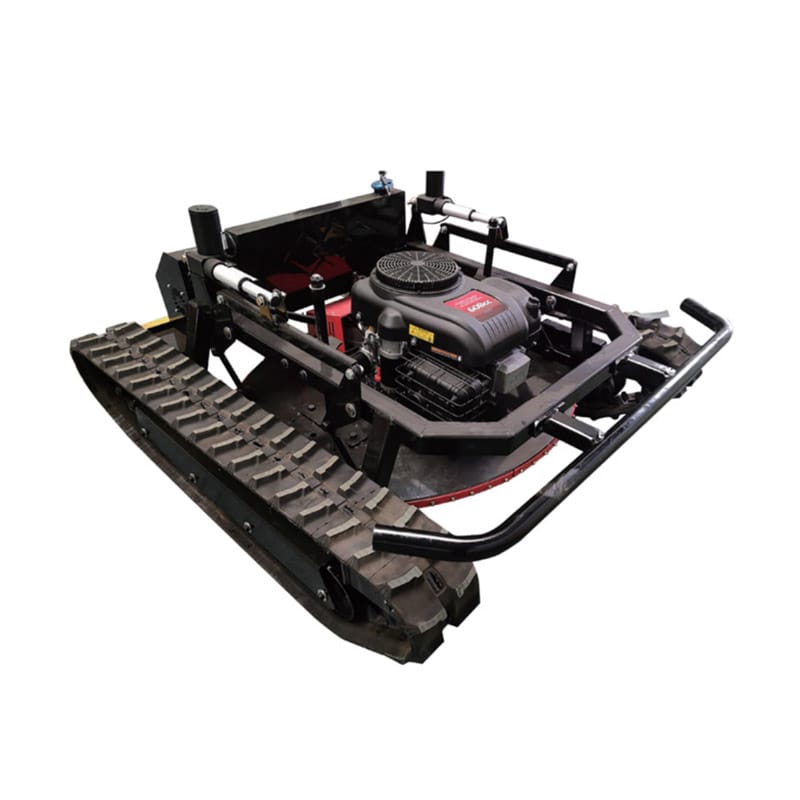
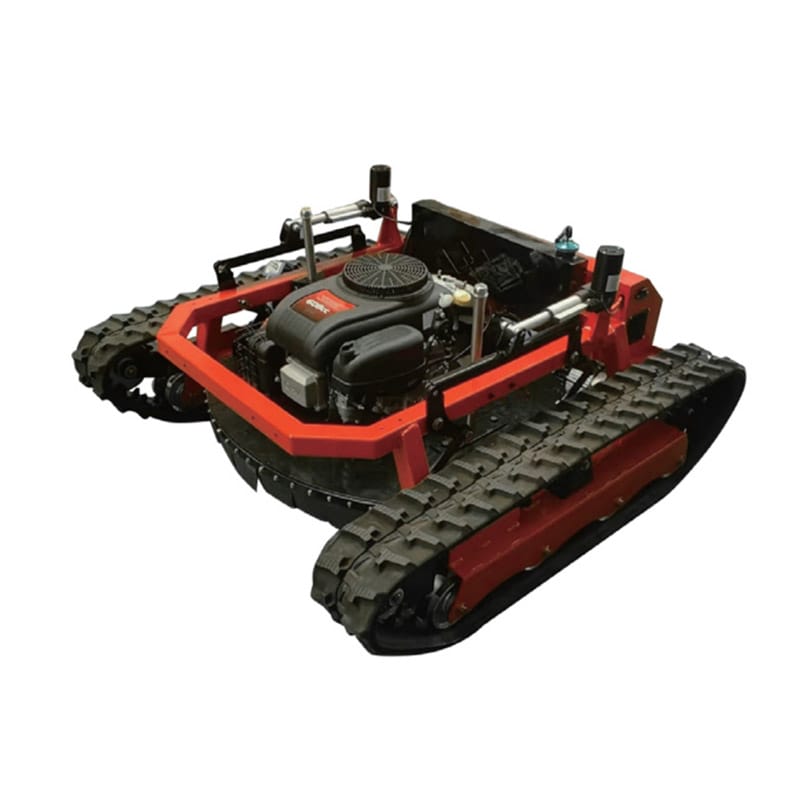
A tracked remote control lawn mower improves slope performance by increasing ground contact and traction. The track system helps the machine grip the surface more effectively, especially on loose soil, grass-covered slopes, and uneven embankments.
Common slope applications include:
- Highway embankments
- Riverbanks
- Dam slopes
- Hillside properties
- Drainage slopes
- Railway edges
For these areas, the value of remote operation is clear. The operator does not need to sit on the machine or walk directly across dangerous terrain.
Roadside Vegetation Control
Roadside vegetation management requires both efficiency and safety.
Maintenance teams often work close to traffic, guardrails, drainage ditches, and uneven road shoulders. These conditions can make conventional mowing difficult and risky.
A remote control lawn mower allows the operator to remain away from traffic exposure while still maintaining precise control over the machine.
This is especially useful for:
- Road shoulders
- Highway embankments
- Bridge approach areas
- Drainage channels
- Guardrail edges
For municipal and highway maintenance teams, this type of equipment helps reduce manual trimming while improving operational safety.
Solar Farm Vegetation Management
Solar farms require regular vegetation control to prevent grass and weeds from interfering with panel performance and site access.
However, mowing inside solar farms requires compact equipment that can move between rows without damaging infrastructure.
A remote control lawn mower is well suited for this environment because it offers:
- Compact machine width
- Stable movement on uneven ground
- Remote operation around sensitive equipment
- Efficient cutting between solar panel rows
For solar maintenance contractors, this machine helps improve vegetation control while reducing the need for manual labor in restricted areas.
Agricultural Land and Farm Maintenance
Agricultural land often includes mixed terrain, narrow access paths, drainage edges, and uneven ground conditions.
A remote control lawn mower can support farm maintenance by managing overgrown areas that are difficult for larger tractors or standard mowers to access.
Instead of focusing only on open-field mowing, this equipment is more valuable in areas such as field edges, irrigation channels, orchard paths, and sloped sections around agricultural facilities.
Tracked models are especially useful when soil conditions become soft after rain or irrigation. The wider ground contact area improves stability and reduces the risk of wheel slip.
Forestry, Brush, and Rough Terrain Applications
In forestry and rough terrain maintenance, vegetation is often thicker and less predictable than standard grass.
Remote control brush mowers can be used for clearing dense grass, weeds, and light brush in areas where manual work is difficult or inefficient.
Typical applications include:
| Terrain Type | Maintenance Challenge | Machine Benefit |
|---|---|---|
| Forest edges | Thick vegetation | Strong cutting performance |
| Firebreak areas | Overgrown brush | Faster vegetation reduction |
| Trails | Narrow access | Compact machine movement |
| Hillside land | Stability risk | Remote operation improves safety |
| Rough fields | Uneven surface | Tracks improve ground contact |
For land clearing and vegetation control, cutting strength and machine stability are more important than mowing speed alone.
Why Track Systems Matter
The track system is one of the most important features of a professional remote control lawn mower.
Compared with wheels, tracks provide a larger contact area with the ground. This improves traction, weight distribution, and stability during operation.
Track systems are especially useful for:
- Sloped terrain
- Wet ground
- Loose soil
- Rough surfaces
- Dense vegetation areas
For professional users, this improves both safety and machine control.
Cutting System Selection
The cutting system directly affects machine performance.
Different mowing conditions require different cutting structures.
| Cutting System | Best For | Main Advantage |
|---|---|---|
| Rotary blade | Grass and general vegetation | Efficient cutting on open areas |
| Flail mower | Dense grass and weeds | Better for rough vegetation |
| Heavy-duty cutter | Brush and overgrowth | Stronger cutting force |
Choosing the correct cutting system helps improve work efficiency and reduces unnecessary strain on the machine.
Key Factors When Choosing a Remote Control Lawn Mower
Selecting the right remote control lawn mower should be based on real working conditions.
Important factors include:
Terrain Gradient
For slope mowing, machine stability is critical. Buyers should consider the slope angle, ground condition, and track design before selecting a model.
Vegetation Density
Light grass does not require the same cutting system as dense weeds or brush. Matching cutting power to vegetation type improves performance.
Working Environment
Roadside, solar farm, agricultural, and forestry applications each require different machine priorities.
Control Distance
A suitable remote-control range helps operators maintain visibility and safe positioning during work.
Machine Width
Compact width is important for solar farms, narrow trails, and restricted access areas.
Remote Control Lawn Mower vs Traditional Mower
A traditional mower is suitable for flat lawns and open areas. A remote control lawn mower is more suitable for professional terrain maintenance.
| Feature | Traditional Mower | Remote Control Lawn Mower |
|---|---|---|
| Operator position | On or behind machine | Safe remote distance |
| Slope safety | Limited | Stronger safety advantage |
| Rough terrain | Limited capability | Better adaptability |
| Dense vegetation | Depends on model | Stronger professional use |
| Best use | Flat lawns | Slopes, roadsides, rough terrain |
This comparison helps users understand that remote control mowers are designed for demanding environments, not just ordinary lawn care.
Common Buying Mistakes to Avoid
Many buyers choose mowing equipment based only on cutting width or engine power. For professional terrain maintenance, this is not enough.
Common mistakes include:
- Ignoring slope stability
- Choosing the wrong cutting system
- Underestimating vegetation density
- Overlooking track design
- Ignoring service and maintenance needs
The best machine should match the actual terrain, vegetation, and daily working requirements.
How Remote Control Lawn Mowers Fit Luyue Machinery’s Product Line
For Luyue Machinery, remote control lawn mowers complement mini tracked excavators, skid steer loaders, and excavator accessories.
This product combination covers several important job site needs:
- Mini tracked excavators for digging and trenching
- Skid steer loaders for material handling and grading
- Remote control lawn mowers for slope and vegetation maintenance
- Excavator accessories for expanding machine functions
For contractors and distributors, this creates a more complete compact equipment solution for construction, landscaping, agriculture, and municipal maintenance markets.
Conclusion
A remote control lawn mower is a professional solution for difficult terrain maintenance. Its main value is not only mowing grass, but improving safety, access, and efficiency in areas where traditional equipment has limitations.
Key points:
- Ideal for slopes, roadsides, solar farms, and rough terrain
- Remote operation improves operator safety
- Track systems improve stability and traction
- Cutting system selection affects performance
- Best suited for professional maintenance applications
For buyers who need reliable equipment for complex mowing conditions, a remote control lawn mower is a practical and increasingly important machine.
FAQ
What is a remote control lawn mower used for?
A remote control lawn mower is used for slope mowing, roadside vegetation control, solar farm maintenance, agricultural land management, and rough terrain mowing.
Is a remote control lawn mower suitable for steep slopes?
Yes. Tracked remote control lawn mowers are designed to improve traction and stability on slopes while allowing operators to work from a safer distance.
Can remote control lawn mowers cut thick weeds and brush?
Yes. Many professional models can handle dense grass, weeds, and light brush, especially when equipped with the right cutting system.
Why are tracks better than wheels for slope mowing?
Tracks provide better ground contact, traction, and weight distribution, which improves stability on slopes and uneven terrain.
Who commonly uses remote control lawn mowers?
They are commonly used by municipal maintenance teams, highway contractors, solar farm operators, agricultural users, landscaping companies, and land management contractors.