
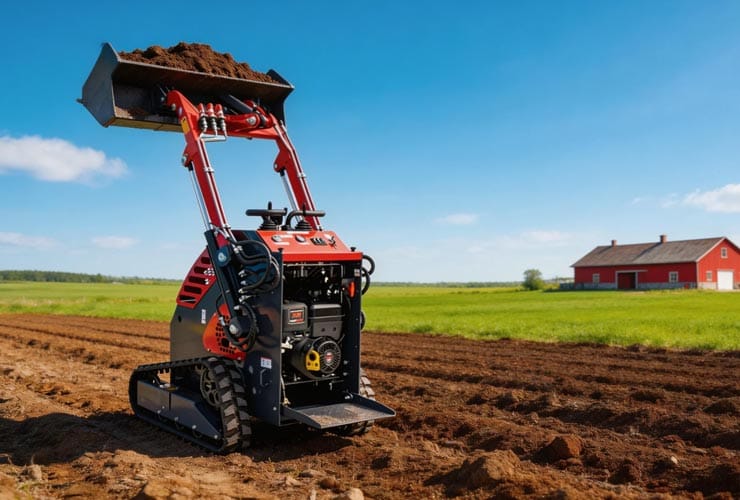
A skid steer loader is only as useful as the attachment working at the front of it. A bucket may be all a contractor needs for one project, while another job calls for a grapple, auger, breaker, or grading attachment.
The challenge is that attachment selection is not simply a matter of choosing the largest or most versatile tool. Hydraulic flow, machine capacity, attachment weight, ground conditions, and the space available on the job site all have a direct effect on how well the combination will work.
For contractors and equipment buyers, the better approach is to start with the work that needs to be done and then match the attachment to the loader.
Table of Contents
Start With the Job, Not the Attachment
Before comparing attachments, look at the actual work cycle.
A landscaping contractor moving soil around residential properties has very different requirements from a construction crew breaking concrete or an agricultural operator handling brush and timber. Even when they use the same skid steer loader, the attachment configuration can be completely different.
A general-purpose bucket is often the starting point because it can handle loose material, cleanup, loading, and basic grading. Once the job becomes more specialized, a dedicated attachment can make the machine much more productive.
| Job | Common Attachment | Main Use |
|---|---|---|
| Moving soil and gravel | General-purpose bucket | Loading and material handling |
| Landscaping | Bucket or grading attachment | Site preparation and leveling |
| Handling timber and brush | Grapple | Picking up irregular materials |
| Fence installation | Auger | Drilling post holes |
| Concrete breaking | Hydraulic breaker | Demolition and repair |
| Vegetation management | Brush cutter or mower | Cutting grass and brush |
| Site cleanup | Bucket or grapple | Collecting debris |
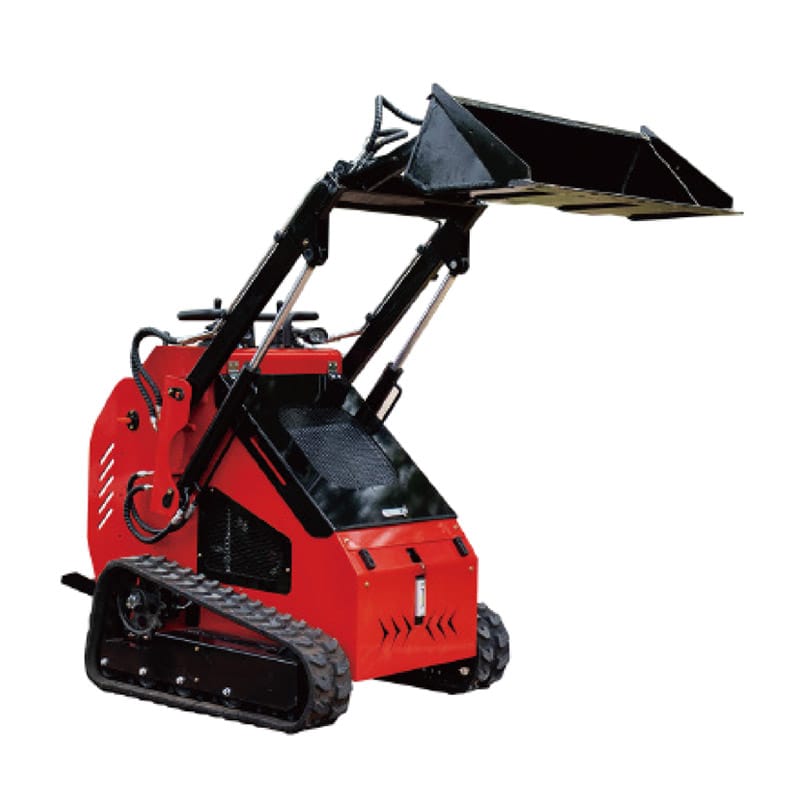
This is also where the type of loader matters. Luyue’s current skid steer range includes both crawler and wheel models, with different dimensions and configurations for compact work.
Hydraulic Flow Is One of the First Specifications to Check
Powered attachments rely on the loader’s auxiliary hydraulic system. If the hydraulic requirements of the attachment and the loader do not match, the machine may not perform as expected.
This is particularly relevant for hydraulic breakers, augers, brush cutters, trenchers, and other attachments with hydraulic motors.
Suppose an attachment is designed to work within a particular hydraulic flow range. Putting it on a compact loader with insufficient flow may result in slow operation and poor working performance. Increasing the attachment size will not solve the problem.
Before ordering a hydraulic attachment, compare the loader’s auxiliary flow and pressure with the attachment manufacturer’s specifications.
Luyue’s mini wheel skid steer loader LY-S380, for example, publishes hydraulic system specifications as part of its machine data. This type of information is what buyers should use when checking attachment compatibility rather than relying on attachment size alone.
For international buyers, it is also worth confirming the hydraulic coupling configuration before shipment. A machine and attachment can be mechanically compatible while still requiring different hydraulic connections.
Attachment Weight Can Change How the Loader Handles
The attachment itself becomes part of the machine’s working load.
This matters most when lifting or carrying heavy material. A lightweight bucket filled with mulch behaves very differently from a heavy grapple carrying timber.
The attachment’s own weight reduces the capacity available for the working load. It also changes the balance of the machine, particularly when the load is carried away from the loader.
That does not mean a lighter attachment is always better. A heavier attachment may be necessary for a particular application. The important point is to look at the complete combination rather than the attachment in isolation.
For material-handling work, buyers should look at the loader’s rated operating capacity, attachment weight, load density, and lift height together.
Choosing a Bucket for General Material Handling
For many skid steer owners, the bucket will spend more time on the machine than any other attachment.
A standard bucket is suitable for moving materials such as soil, sand, gravel, mulch, and general construction debris. But bucket selection still deserves some attention because capacity, width, and material construction affect how the machine performs.
A wider bucket can cover more ground during grading and cleanup, but that advantage disappears if the machine has difficulty maneuvering in the available space.
Material density is another consideration. A bucket that works well with lightweight landscaping material may not be appropriate for dense gravel or other heavy materials.
On a compact residential site, a slightly narrower bucket may actually be more useful because the operator can position the machine more easily around buildings, walls, driveways, and existing landscaping.
In other words, bucket capacity should be matched to the loader and the material, not selected simply because it offers the largest volume.
When a Grapple Is Better Than a Bucket
Some materials are awkward to handle with a conventional bucket.
Branches, logs, brush, demolition debris, and other irregular objects are good examples. They can be difficult to contain, particularly when the material is long or uneven.
A grapple solves part of this problem by clamping the material rather than simply carrying it in an open bucket.
For landscaping contractors, a grapple can be useful during clearing and cleanup. Agricultural users may find it useful for handling branches, timber, or other bulky materials.
The main consideration is the load itself. A grapple should be sized for the loader and the material being handled. The jaw opening also needs to be large enough for the objects the operator expects to pick up.
Visibility deserves attention too. An attachment that makes it difficult to see the load or the working area can slow down the job and make positioning more difficult.
Grading Requires More Control Than Simple Loading
Moving soil is relatively straightforward. Producing a consistent finished surface is not.
For grading work, the attachment needs to give the operator enough control to remove material gradually and maintain a consistent surface.
This is particularly noticeable in landscaping. A contractor may need to prepare an area around a house, driveway, retaining wall, or garden where there is very little room for correcting mistakes.
A grading attachment that is too large can make the machine harder to position. On a larger open site, however, additional working width may reduce the number of passes required.
The best choice depends on the scale of the site and the level of control required.
Auger Attachments for Post Holes and Small Foundations
An auger turns a skid steer loader into a compact drilling machine.
This is useful for fence posts, signs, landscaping structures, agricultural fencing, and similar work where repeated holes are required.
The diameter and depth of the hole are obvious considerations, but soil conditions are just as important.
Loose soil is relatively easy to drill. Compacted ground, gravel, clay, and areas containing roots can require considerably more effort and a different bit configuration.
The loader’s hydraulic performance also needs to be matched to the auger. If the hydraulic system cannot maintain adequate performance under load, drilling speed can suffer.
For contractors who frequently install fences or posts, an auger can be a much more practical addition than bringing a separate drilling machine to every small project.
Hydraulic Breakers for Concrete and Hard Materials
A hydraulic breaker is useful when the job involves breaking concrete, masonry, pavement, or similar materials.
The important point is to match the breaker to the loader rather than simply choosing a heavy breaker.
Breaker weight, hydraulic flow, hydraulic pressure, mounting configuration, and the loader’s operating capacity all need to be considered.
The working environment also matters. Breaking concrete next to an existing structure is a different job from breaking a large open slab. Machine positioning, operator visibility, and debris control become increasingly important as the work becomes more confined.
For safety-related information, operators can refer to established skid steer loader safety guidance from the Association of Equipment Manufacturers, particularly when working with attachments and hydraulic equipment.
Brush Cutters and Mowing Attachments
Vegetation management is another area where a skid steer loader can become considerably more versatile.
A hydraulic mower or brush cutter can be useful for contractors maintaining overgrown land, roadsides, construction sites, or large properties.
But the attachment needs to suit the vegetation and terrain.
Tall grass is relatively straightforward. Dense brush, small woody growth, uneven ground, rocks, and hidden debris present a different set of conditions.
Attachment guarding and operator visibility become particularly important in this type of work. The machine should also be operated according to the manufacturer’s instructions and the requirements of the specific attachment.
For contractors who already own a skid steer loader, adding a suitable vegetation-management attachment can expand the range of work the machine can handle without adding another dedicated power unit.
Machine Width Matters More Than Many Buyers Expect
Attachment selection is often discussed in terms of hydraulic flow and capacity, but physical dimensions can be just as important.
Consider a contractor working in a narrow backyard. A wide attachment may look productive on paper, yet the machine may spend more time repositioning because there is not enough room to maneuver.
Luyue’s crawler skid steer loader LY-380S has a published overall width of 1,033 mm and a turning radius of 1,307 mm. These dimensions are particularly relevant when the machine will be used in compact working areas.
The attachment needs to work within those same physical limitations.
For compact construction and landscaping projects, a slightly smaller attachment that can be positioned accurately may deliver better results than a larger tool that forces the operator to make repeated adjustments.
Quick Attachment Changes Can Save More Time Than a Larger Tool
A skid steer loader becomes especially useful when the operator can change from one attachment to another without bringing another machine onto the site.
Luyue’s skid steer loader range is designed around multi-attachment use, which fits applications where the machine may move between material handling, grading, cleanup, and other tasks.
Consider a small landscaping project.
The operator may start by using a bucket to move soil, switch to a grading attachment to prepare the surface, and then use a grapple to clear branches and construction debris.
The loader itself has not changed. Only the tool at the front has.
That flexibility is one of the main reasons skid steer loaders remain popular with contractors who work across different types of projects.
How Attachment Width Affects Productivity
Wider is not automatically faster.
A wide attachment can reduce the number of passes required on an open site, but it can also make the machine harder to maneuver around obstacles.
The right width depends on the relationship between the machine and the site.
For open agricultural or construction areas, working width may have a greater influence on productivity. For residential landscaping or municipal maintenance, compact dimensions may be more valuable.
This is one reason equipment buyers should avoid selecting attachments from specifications alone. A tool that looks efficient in a product catalogue may not be efficient on the actual job site.
Match the Attachment to the Material
The same attachment can behave very differently depending on what it is handling.
A bucket moving dry soil is not working under the same conditions as one carrying wet clay. A grapple handling branches has different requirements from one handling demolition debris.
Material density, moisture, size, shape, and abrasiveness all affect attachment performance.
For heavy or abrasive materials, attachment construction and wear resistance become more important. For irregular materials, gripping and load control may matter more than bucket volume.
This is where experience with the actual application becomes valuable. The right attachment is not necessarily the one with the highest nominal capacity. It is the one that works efficiently with the material encountered every day.
What to Check Before Buying an Attachment
Before ordering, put the loader specifications and attachment specifications side by side.
| Check | Why It Matters |
|---|---|
| Hydraulic flow | Confirms compatibility with powered attachments |
| Hydraulic pressure | Ensures the attachment can operate within its required range |
| Attachment weight | Affects machine capacity and balance |
| Rated operating capacity | Determines practical working loads |
| Attachment width | Influences access and maneuverability |
| Mounting system | Confirms mechanical compatibility |
| Hydraulic couplers | Ensures the attachment can be connected correctly |
| Working dimensions | Helps determine whether the attachment suits the site |
It is also worth asking how often the attachment will be used.
There is little reason to purchase a highly specialized attachment if it will only be used once or twice a year. On the other hand, a contractor using the same tool every day should pay close attention to attachment durability, maintenance, and ease of connection.
Common Mistakes When Choosing Skid Steer Attachments
One of the most common mistakes is choosing the attachment first and checking the machine afterward.
The machine’s hydraulic system and rated capacity put real limits on what it can do.
Another mistake is choosing based on size alone. A larger bucket or heavier attachment may look more capable, but the extra weight can reduce the useful load the machine can carry.
Ignoring the working environment is another problem. An attachment that performs well on an open site may be frustrating to use around buildings, trees, fences, or narrow access points.
Finally, some buyers underestimate how much the attachment affects the overall machine. Once installed, it changes the machine’s weight distribution, dimensions, visibility, and operating characteristics.
The loader and attachment should always be treated as one system.
Choosing a Skid Steer Loader and Attachment Package
If you are buying a skid steer loader for commercial work, it can make sense to decide on the attachment package at the same time as the machine.
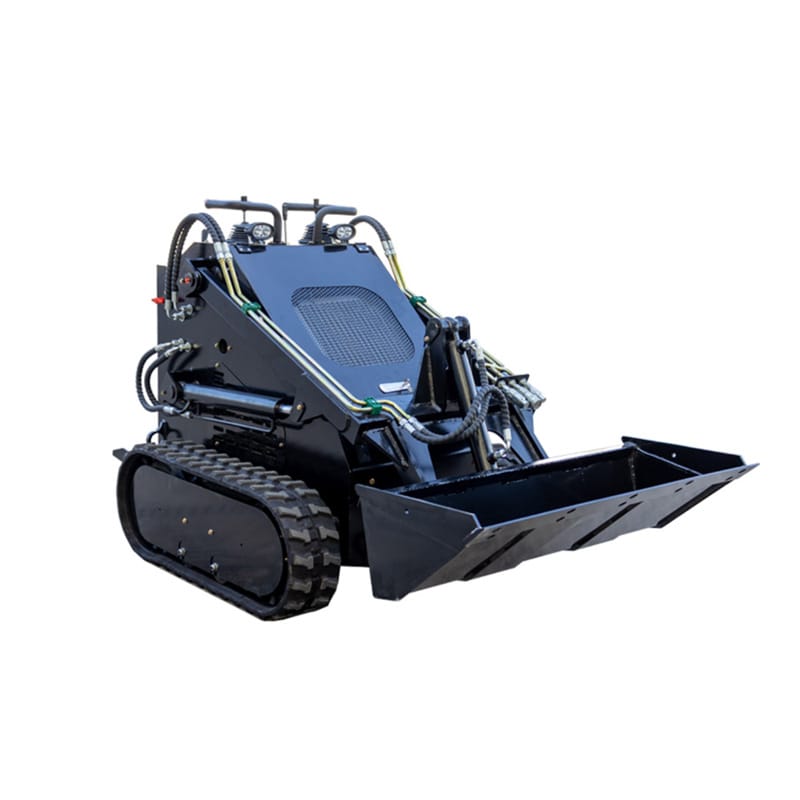
Luyue currently offers several skid steer configurations, including the crawler skid steer loader LY-380S, mini wheel skid steer loader LY-S380, mini skid steer loader LY-S360L, LY-HTS382T, and LY-380T.
The right configuration depends on where the machine will work and what it will be expected to do.
A contractor focused on compact landscaping projects may prioritize small dimensions and maneuverability. A customer handling heavier materials may place greater emphasis on operating capacity and hydraulic performance.
For distributors, attachment combinations can also make a machine more useful across different customer applications.
Why Application Should Drive the Configuration
There is no single “best” skid steer loader attachment.
A landscaping contractor may get more value from a bucket, grading tool, and grapple. A fencing contractor may put an auger at the top of the list. A demolition contractor may need a breaker. An agricultural customer may prioritize attachments for material and vegetation handling.
The machine should be configured around the work rather than the other way around.
That approach also makes it easier to decide which attachments are genuinely worth purchasing and which ones are unnecessary additions.
Working With a Compact Machinery Supplier
For overseas buyers, attachment selection is only one part of the purchasing process. It is also important to confirm machine specifications, attachment compatibility, configuration requirements, spare parts support, and technical documentation before placing an order.
Luyue Machinery supplies compact construction equipment including mini tracked excavators, skid steer loaders, remote control lawn mowers, excavator accessories, and crawler jaw crushers. Its current skid steer range provides several compact configurations for different working conditions.
For distributors and contractors, discussing the intended application before selecting the machine can help avoid an attachment package that looks suitable on paper but does not fit the actual work.
Conclusion
The right skid steer loader attachment depends on much more than the attachment itself. Hydraulic performance, machine capacity, attachment weight, dimensions, material, and working conditions all have to work together.
Start with the job, identify the material and working environment, then choose the attachment that fits the loader. That approach usually produces a more practical machine configuration and avoids paying for capabilities that will rarely be used.
FAQ
What is the most useful skid steer loader attachment?
A general-purpose bucket is usually the most versatile starting point because it can handle loading, moving loose materials, cleanup, and basic grading. Contractors with more specialized work may get greater value from a grapple, auger, breaker, or grading attachment.
How do I know if a skid steer attachment is compatible?
Check the attachment’s hydraulic flow, hydraulic pressure, weight, mounting system, and operating requirements against the specifications of your skid steer loader.
Can a compact skid steer loader use hydraulic attachments?
Yes, provided the attachment’s hydraulic requirements fall within the loader’s specified operating range. The machine’s auxiliary hydraulic system should always be checked before purchasing a powered attachment.
Is a crawler or wheel skid steer better for attachments?
The attachment itself does not determine whether a crawler or wheel configuration is better. The choice depends mainly on ground conditions, maneuverability, traction requirements, and the type of work being performed.
Are larger attachments better?
Not necessarily. A larger attachment can increase productivity in some applications, but it may also increase weight and reduce maneuverability. The attachment should be matched to the machine’s capacity and the job site’s available space.
What attachments are commonly used for landscaping?
Buckets, grading attachments, grapples, augers, and vegetation-management attachments are commonly used for different landscaping tasks. The best combination depends on whether the contractor focuses on excavation, grading, planting, cleanup, or vegetation management.
How important is hydraulic flow?
Hydraulic flow is critical for powered attachments. If the attachment requires more hydraulic flow than the loader can provide, its performance may be limited even if the attachment physically fits the machine.