
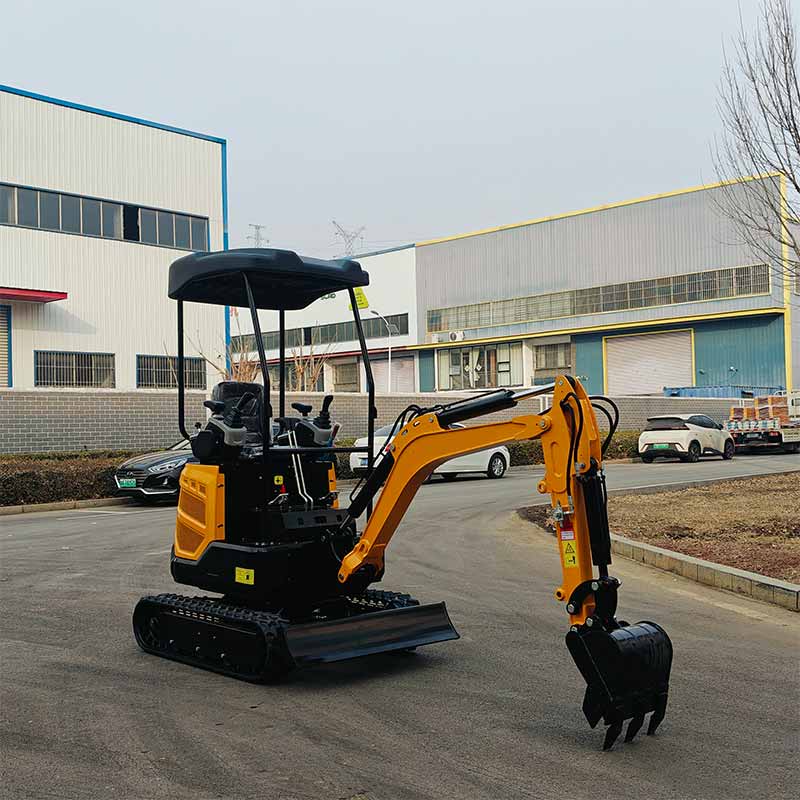
Choosing a mini tracked excavator is not simply a matter of selecting the smallest machine available. On confined construction sites, the right excavator must fit through the available access route, provide sufficient digging performance, remain stable under the expected ground conditions, and work efficiently around existing structures and utilities.
For contractors working in residential construction, landscaping, utility installation, agriculture, and municipal maintenance, machine selection directly affects excavation accuracy, productivity, transportation, and job-site access.
A properly selected mini tracked excavator should provide enough hydraulic and digging performance for the application without introducing unnecessary size or maneuvering limitations.
Table of Contents
What Makes a Mini Tracked Excavator Suitable for Confined Job Sites?
A confined job site creates several equipment constraints that do not exist on an open construction site.
The machine may need to pass through a narrow gate, operate between buildings, excavate beside an existing foundation, or work around landscaping that must remain undisturbed.
This makes the following characteristics particularly important:
| Selection Factor | Why It Matters on Confined Sites |
|---|---|
| Overall machine width | Determines whether the excavator can access the work area |
| Overall height | Important when entering buildings or working beneath obstacles |
| Tail swing | Affects clearance around structures |
| Operating weight | Influences transportation and ground pressure |
| Digging depth | Determines whether the machine can complete the required excavation |
| Hydraulic flow | Affects attachment compatibility |
| Track configuration | Influences traction and stability |
| Boom configuration | Determines working reach and excavation flexibility |
The ideal machine is therefore not necessarily the most powerful model. It is the machine that provides sufficient performance within the physical limitations of the site.
Why Zero Tail Swing Matters in Urban Construction
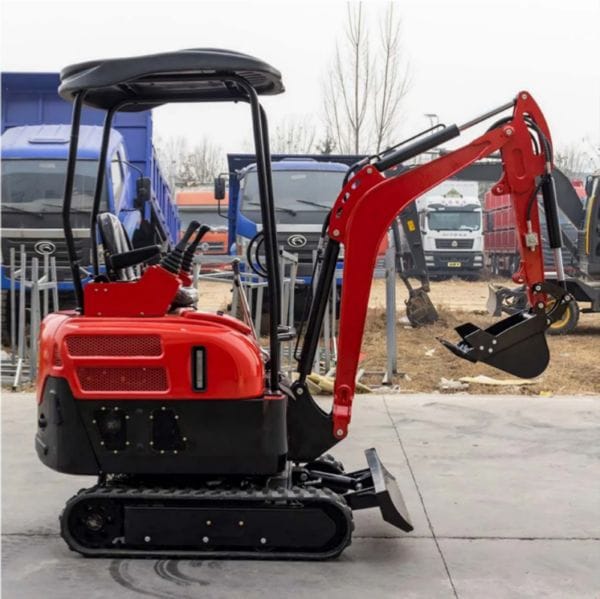
Tail swing is one of the most important specifications when an excavator needs to operate close to buildings, walls, roads, or other obstacles.
A conventional excavator requires sufficient rear clearance for the counterweight to rotate during operation. On a restricted site, this can significantly limit where the machine can be positioned.
A zero tail swing mini excavator reduces this limitation by keeping the rear of the machine within or close to the track footprint during rotation, depending on the specific design.
This can be particularly useful for:
- Residential foundation work
- Utility trenching
- Roadside excavation
- Building renovation
- Landscaping
- Municipal repair
Luyue’s mini crawler excavator range specifically highlights zero-tail-swing design as one of its product characteristics.
However, buyers should always check the manufacturer’s actual tail-swing dimensions and operating envelope rather than assuming that every compact excavator offers the same clearance.
Machine Width Should Be Evaluated Before Digging Performance
One of the most common equipment-selection mistakes is checking digging depth and engine power before checking access dimensions.
A machine that cannot physically reach the work area has no practical value regardless of its digging performance.
Before selecting a mini excavator, measure the narrowest point along the entire transportation route.
This may include:
- Property gates
- Driveways
- Side passages
- Building entrances
- Temporary access paths
- Fencing openings
The measurement should account for the actual operating configuration rather than relying solely on nominal machine width.
If the machine uses retractable tracks, the buyer should also verify the minimum and maximum track widths and understand whether the machine remains stable at the narrower configuration.
How Operating Weight Affects Equipment Selection
Operating weight influences several aspects of excavator operation.
A heavier machine generally provides greater physical stability and may support higher digging performance, but it also places greater demands on transportation and ground conditions.
A lighter machine can be easier to transport and may be more appropriate for residential landscaping or restricted-access work.
The correct operating weight therefore depends on the application.
| Application | Typical Priority |
|---|---|
| Backyard landscaping | Compact dimensions |
| Utility trenching | Digging depth and maneuverability |
| Foundation preparation | Stability and digging performance |
| Agricultural work | Ground adaptability |
| Municipal maintenance | Versatility and transportability |
Luyue’s current mini crawler excavator range covers approximately 0.8 to 3.5 tons of operating weight, giving buyers several size classes for different compact excavation requirements.
The exact model should be selected according to the required excavation depth, attachment, terrain, and access limitations.
Digging Depth Should Match the Actual Application
Digging depth is another specification that should be evaluated against the project rather than selected by machine class alone.
A shallow utility trench may require significantly less digging depth than foundation preparation or drainage construction.
Before purchasing equipment, determine:
- Required maximum digging depth
- Typical working depth
- Required trench width
- Required reach from the machine’s operating position
- Ground conditions at the excavation site
It is also important to distinguish between maximum theoretical digging depth and the depth that can be achieved efficiently under real working conditions.
A machine operating near its maximum reach and depth may not provide the same breakout performance or cycle efficiency as it does closer to the machine.
Hydraulic Performance and Attachment Selection
A mini tracked excavator becomes significantly more versatile when equipped with the correct attachments.
Attachment compatibility should be evaluated together with hydraulic performance, machine stability and operator safety. Industry organizations such as AEM provide resources covering compact equipment safety and attachment applications.
Hydraulic attachments may have different requirements for:
- Hydraulic flow
- Hydraulic pressure
- Auxiliary circuit configuration
- Coupler compatibility
- Attachment weight
Common excavator attachments include:
| Attachment | Typical Application |
|---|---|
| General-purpose bucket | Excavation and material handling |
| Narrow trenching bucket | Utility installation |
| Grading bucket | Final grading and surface shaping |
| Hydraulic breaker | Concrete and rock breaking |
| Auger | Post and foundation drilling |
| Grapple | Material and debris handling |
Luyue lists multiple excavator accessories and highlights quick-change compatibility and heavy-duty steel construction within its accessories product category.
For professional users, matching the attachment to the excavator’s hydraulic system is essential.
Why Ground Conditions Influence Mini Excavator Selection
Two sites with identical excavation requirements can still require different excavators because of differences in soil and terrain.
Soft ground, wet soil, loose fill, gravel, and compacted clay each affect machine traction and stability differently.
Tracked undercarriages are particularly useful because they provide a larger ground-contact area than conventional wheels.
This can improve:
- Traction
- Stability
- Weight distribution
- Mobility across uneven terrain
However, tracks do not make an excavator suitable for every slope or soil condition. Operators still need to consider machine weight, center of gravity, slope angle, and manufacturer operating limits.
Mini Excavators for Residential Construction
Residential construction is one of the strongest use cases for compact excavators.
The equipment may need to work in a backyard with limited access while avoiding damage to existing structures and finished surfaces.
Typical applications include:
- Foundation excavation
- Drainage installation
- Water and utility trenching
- Landscaping preparation
- Retaining wall construction
In these environments, compact dimensions can be more valuable than maximum excavation capacity.
A smaller excavator can often be positioned closer to the excavation area, reducing the need for excessive repositioning.
Mini Excavators for Utility Trenching
Utility installation requires controlled excavation rather than simply moving large volumes of soil.
A mini tracked excavator can be used for trenches associated with:
- Water lines
- Drainage
- Electrical conduit
- Communication infrastructure
- Irrigation systems
The correct bucket width is particularly important.
Using an excessively wide bucket can increase the amount of soil removed and subsequently increase backfilling requirements. A properly sized trenching bucket can provide better control over excavation dimensions.
Operators should also take particular care around existing underground utilities. Equipment selection does not replace proper utility locating, site marking, and excavation procedures.
Mini Excavators for Landscaping Contractors
Landscaping requires a combination of excavation capability and surface control.
Contractors may need to excavate for ponds, retaining walls, drainage systems, planting areas, or hardscape foundations while working around existing trees and finished surfaces.
A mini tracked excavator provides several advantages:
- Compact access
- Precise digging
- Track-based stability
- Attachment flexibility
- Easy repositioning
For landscaping contractors, the ability to move between different job types can be just as important as maximum digging force.
Mini Excavators for Agricultural Operations
Agricultural applications often involve more variable terrain than conventional construction sites.
Compact excavators can support:
- Irrigation work
- Drainage maintenance
- Ditch excavation
- Farm infrastructure construction
- Small-scale land preparation
Luyue identifies agricultural operations as one of its application areas, alongside urban construction, municipal maintenance, and landscape contracting.
In agricultural environments, buyers should pay particular attention to track performance and ground pressure because operating conditions can change considerably with weather.
Transportation Requirements Should Be Considered Early
A compact excavator may be easy to operate on site but still create transportation challenges if the complete equipment package exceeds the available trailer capacity.
Transportation planning should consider:
- Operating weight
- Attachment weight
- Trailer capacity
- Loading method
- Overall transport dimensions
If several attachments are transported with the machine, their combined weight and loading arrangement should also be considered.
For contractors moving between multiple residential or municipal projects each week, transportation efficiency can have a significant effect on daily productivity.
Common Mistakes When Buying a Mini Tracked Excavator
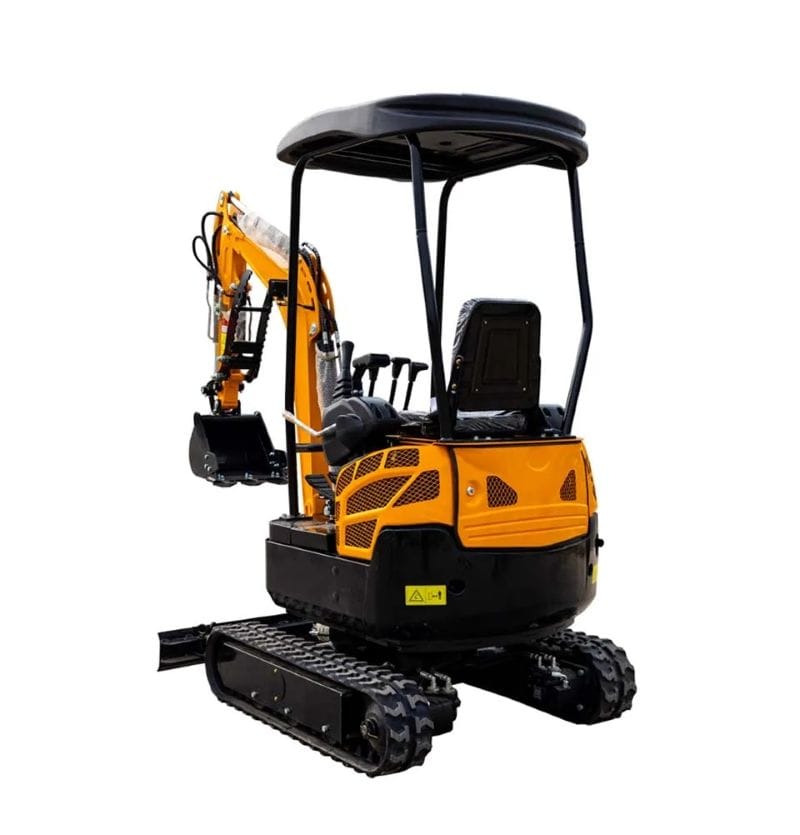
Choosing the Largest Machine Available
More power is not automatically better.
An oversized excavator may have difficulty accessing the work area, increase transportation requirements, and create unnecessary ground disturbance.
Ignoring Attachment Requirements
A machine may have adequate digging performance but lack the hydraulic configuration required for the intended attachment.
Measuring Only the Job Site Entrance
The entire access route should be measured. A machine may pass through a gate but fail to maneuver through a narrow side passage.
Ignoring Tail Swing
Rear clearance can become a major limitation when excavating alongside buildings or roads.
Focusing Only on Maximum Specifications
Maximum digging depth and reach are useful reference values, but real productivity depends on how the machine performs within the normal operating range.
When a Mini Tracked Excavator Is the Right Choice
A mini tracked excavator is generally well suited to projects where compact access and controlled excavation are important.
It is particularly appropriate when the project involves:
- Restricted access
- Residential construction
- Utility trenching
- Landscaping
- Agricultural maintenance
- Municipal repair
- Light excavation around existing structures
For larger open excavation projects, a larger excavator may provide better production rates. The key is to match machine size to the actual workload.
How Luyue Machinery Supports Compact Excavation Applications
Luyue Machinery’s product range includes mini crawler excavators from approximately 0.8 to 3.5 tons, as well as skid steer loaders, remote control lawn mowers, excavator accessories, and crawler jaw crushers.
Its current mini excavator range includes models such as the LY08 0.8T, LY10G, LY-10H, LY12 1.2T, LY15, LY18-1, LY20-1, LY20Pro, LY25 2.5T, and LY30-2.
This range allows buyers to approach equipment selection according to application requirements rather than treating every compact excavation project as the same.
Luyue also states that it supports OEM branding, configuration, and attachment customization, which can be relevant for equipment distributors and international machinery buyers with specific market requirements.
Conclusion
Choosing a mini tracked excavator for a confined job site requires more than comparing engine power.
The most important considerations are:
- Access width and machine dimensions
- Tail-swing configuration
- Operating weight
- Digging depth and reach
- Hydraulic attachment compatibility
- Track performance
- Transportation requirements
The right excavator is the one that provides sufficient digging performance while fitting the physical and operational constraints of the site.
For contractors, distributors, and equipment buyers, evaluating the machine against actual working conditions is the most reliable way to select compact excavation equipment.
FAQ
What size mini tracked excavator is best for residential construction?
The appropriate size depends on access width, required digging depth, soil conditions, and the type of work. Smaller models are often suitable for restricted residential sites, while larger compact excavators may be preferable for deeper excavation and heavier work.
What is zero tail swing on a mini excavator?
Zero tail swing refers to an excavator design where the rear of the machine remains within or very close to the track footprint during rotation. This reduces the clearance required around the machine.
How do I know if a mini excavator will fit through a gate?
Measure the narrowest point of the complete access route and compare it with the machine’s actual minimum operating width. Also consider the operator’s visibility and available turning space.
What attachments can be used with a mini tracked excavator?
Depending on the machine’s hydraulic system, common attachments include buckets, trenching buckets, hydraulic breakers, augers, grading buckets, and grapples.
Are mini tracked excavators suitable for agricultural work?
Yes. Compact excavators can be used for irrigation, drainage, ditch maintenance, and small-scale agricultural infrastructure projects, provided the machine is properly matched to the terrain.
What is more important, excavator size or hydraulic performance?
Neither should be considered separately. The correct machine needs sufficient hydraulic and digging performance while remaining appropriate for the site’s access, terrain, transportation, and attachment requirements.
How should I choose between different mini excavator models?
Start with the project requirements: access dimensions, digging depth, reach, soil conditions, attachment requirements, operating weight, and transportation limitations. Then compare models against those requirements rather than selecting based solely on maximum specifications.