
Table of Contents
Solar photovoltaic installations are growing faster than ever. By the end of 2025, global solar capacity exceeded 2 terawatts, and vegetation management has become one of the most persistent operational challenges for solar farm owners and O&M contractors.
The space under and between solar panels creates a unique mowing environment. Standard walk-behind mowers cannot fit. Ride-on machines are too wide for narrow rows. And sending workers into tight, electrically hazardous zones with spinning blades is a liability no one wants.
This guide walks you through every factor that matters when selecting a lawn mower for solar farms and other low-clearance areas — from machine dimensions and cutting specs to remote control capabilities, power source trade-offs, and total cost of ownership. Whether you manage a 5 MW ground-mount array or bid on O&M contracts for utility-scale installations, this article will help you make a data-driven equipment decision.
Why Solar Farms Need Specialized Mowers
A solar farm is not a lawn. It is an industrial vegetation management site with constraints that standard turf equipment simply cannot handle. Here is why:
1. Extreme Clearance Restrictions
Ground-mounted solar panels are typically installed with a ground clearance of 18 to 36 inches (450–900 mm). The vegetation underneath still needs regular cutting to prevent shading losses, fire risk, and pest habitat. Most conventional mowers exceed this height or cannot maneuver into the space at all.
2. Tight Row Spacing
Panel rows in utility-scale solar farms are spaced 10 to 20 feet apart. Between rows, the space is even narrower. Large ride-on mowers struggle to turn, and their discharge chutes can throw debris into panels, causing micro-cracks or soiling.
3. Electrical Safety Zones
Working near live DC wiring, junction boxes, and inverters introduces serious electrocution risk. Metal mowing decks can contact hidden wiring. Operator proximity to electrical infrastructure increases the severity of any accident.
4. Scale and Efficiency Demands
A typical 50 MW solar farm covers 300 to 500 acres of land. Mowing this area with residential-grade equipment would require weeks of labor. Solar farm O&M budgets demand mechanized solutions that can cover 5 to 10 acres per day per machine.
5. Slope and Terrain Variation
Solar farms are often built on marginal or uneven land — hillsides, former agricultural fields, or sandy terrain. Mowers must handle slopes of 15° to 40° without tipping, and tracked propulsion is almost always preferable to wheels.
Key Insight: Solar farm vegetation management is fundamentally different from landscaping or agriculture. The equipment must be compact enough to fit under panels, safe enough to operate near live electrical systems, and efficient enough to cover hundreds of acres within tight O&M windows.
Understanding Low-Clearance Challenges
“Low-clearance” in the solar industry refers to any area where the vertical space for equipment is restricted. This includes several distinct zones:
Under-Panel Zone
The area directly beneath solar panel arrays. Panel height from ground level typically ranges from 500 mm to 900 mm at the lowest edge. The mower must:
- Have a total machine height below the panel clearance (with safety margin)
- Produce a clean cut without throwing debris upward into panels
- Navigate between support posts and wire management systems
Between-Row Zone
The corridor between panel rows. Width varies from 2 to 6 meters depending on array design. Challenges include:
- Limited turning radius for larger machines
- Potential cable trays or drainage channels at ground level
- Need for consistent cutting height across the full row length
Perimeter and Access Road Zone
Fence lines, access roads, and inverter pad areas often have taller, more aggressive vegetation. These zones require higher cutting capacity but are less constrained by clearance. Many operators use a single multi-function machine that handles both under-panel and perimeter work by swapping attachments.
Key Specs to Evaluate Before Buying
When comparing mowers for solar farm use, focus on these specifications. They matter far more than marketing claims about horsepower or brand reputation.
| Specification | Why It Matters for Solar Farms | Recommended Range |
|---|---|---|
| Machine Height | Must fit under panels with clearance margin | Below 750 mm (30″) |
| Machine Width | Determines ability to navigate between rows | Below 1,000 mm (40″) |
| Cutting Width | Directly impacts daily coverage area | 700–1,000 mm |
| Cutting Height Range | Flexibility for different vegetation types | 20–150 mm adjustable |
| Slope Capability | Solar farms often built on graded land | 0–40° minimum |
| Travel Speed | Affects acres covered per day | 30–60 m/min |
| Remote Control Range | Operator safety distance from electrical zones | 100+ meters |
| Weight | Ground pressure affects soil compaction and cable protection | 300–600 kg |
| Track Type | Tracks vs. wheels for terrain adaptability | Steel-reinforced rubber tracks |
Machine Dimensions: The Non-Negotiable Constraint
This is the single most important specification. If the machine cannot physically fit under your panel array, nothing else matters. Measure the lowest point of your panel edge at ground level, then subtract at least 50 mm (2 inches) as a safety margin. That number is your maximum allowable machine height.
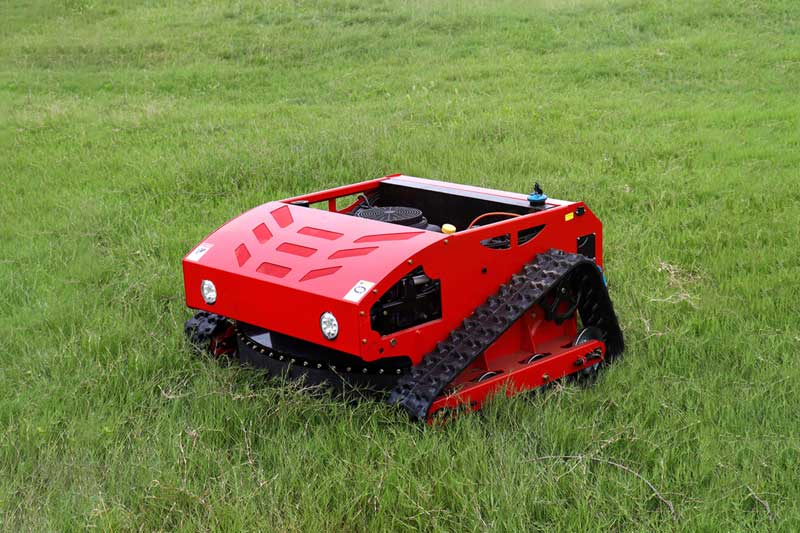
For context, one widely used solar farm mower — the Luyue LY-80PROMAX — stands just 740 mm tall with a footprint of 1,780 × 920 mm. This allows it to operate under panels with 800 mm minimum clearance, covering the majority of ground-mount installations worldwide. Luyue is a professional compact construction equipment manufacturer based in Shandong, China, exporting remote-controlled mowers to solar farms across Europe, the Americas, and Southeast Asia.
Cutting System: Blades vs. Flails
Solar farm mowers typically use one of two cutting systems:
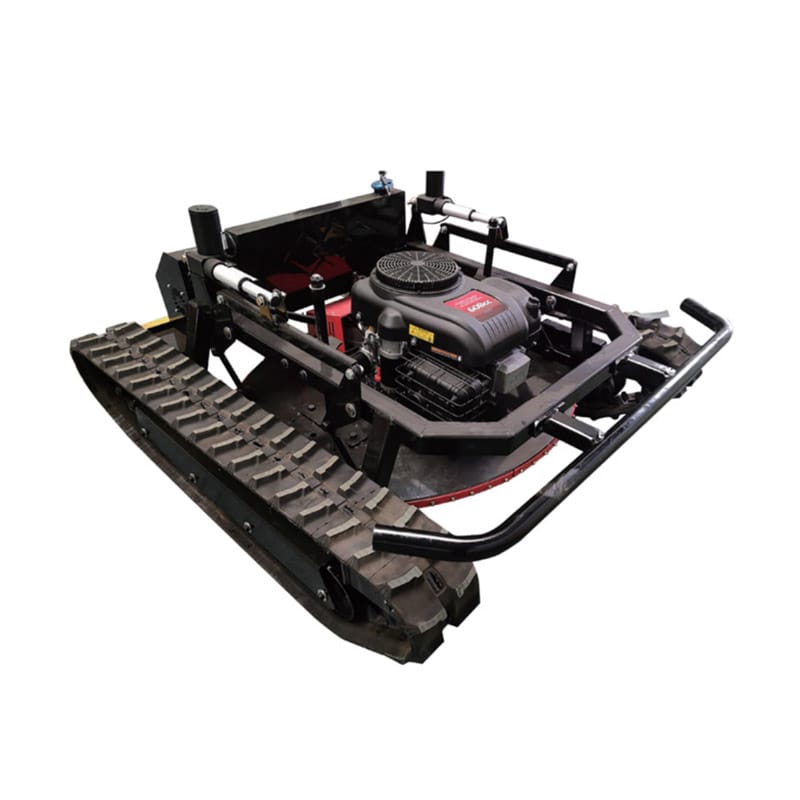
- Rotary blade (reaper) systems: Use multiple free-swinging or fixed blades on a rotating shaft. Best for grass and light vegetation. Faster cutting speed, lower power consumption. The LY-80PROMAX uses a 48-blade manganese steel rotary system with an 800 mm cutting width.
- Flail mower systems: Use Y-shaped or hammer-shaped flails on a horizontal drum. Better for thick brush, woody stems, and mixed vegetation. Heavier, more power-hungry, but more versatile for neglected sites.
For routine solar farm maintenance where vegetation is mowed every 4–8 weeks, rotary blade systems offer the best combination of speed, efficiency, and clean cut quality.
Diesel vs. Electric: Which Power Source Fits Solar Farms?
This is one of the most debated questions in solar farm equipment selection. Both options have legitimate advantages depending on your operational context.
Diesel-Powered Mowers
- Runtime: Continuous operation for 6–10 hours on a single tank. No downtime for charging.
- Power output: Higher torque for thick vegetation and slopes. A 13 kW diesel engine handles grass up to 2 meters tall.
- Refueling speed: A 5-liter tank fills in under 2 minutes. Compare this to hours of charging for batteries.
- Cold weather performance: Diesel engines perform consistently in low temperatures where battery capacity drops significantly.
- Multi-function support: Sufficient PTO power for additional attachments like rotary tillers, ditchers, and snow blades.
Electric/Battery-Powered Mowers
- Zero emissions: Important for sites with environmental compliance requirements or ESG reporting.
- Lower noise: Beneficial for solar farms near residential areas or in noise-restricted zones.
- Lower per-hour energy cost: Electricity is cheaper than diesel per operating hour.
- Less maintenance: No engine oil, filters, or fuel system to service.
The Practical Reality for Solar Farms
For most utility-scale solar farms, diesel-powered remote-controlled mowers remain the practical choice. The combination of all-day runtime, high torque for challenging vegetation, fast refueling, and multi-function capability outweighs the environmental advantages of electric — especially when the solar farm itself is already generating clean energy.
Some operators adopt a hybrid approach: electric mowers for small, noise-sensitive installations, and diesel machines for large-scale O&M contracts. The Luyue remote control mower lineup includes both diesel and electric options to match different project requirements.
Remote Control: The Game-Changer for Solar Farm Safety
Remote-controlled mowers have transformed solar farm vegetation management. Here is why remote operation is no longer optional for professional O&M contractors:
Electrical Safety
Operating a mower near live DC conductors, junction boxes, and grounding systems puts the operator at risk. With remote control, the operator stands 100 to 400 meters away — completely clear of any electrical hazard zone.
Slope Safety
Solar farms on hillside terrain create rollover risk for walk-behind and ride-on mowers. Remote-controlled tracked mowers can operate on slopes up to 40° while the operator stands on stable ground. If you’re also dealing with steep terrain challenges, our guide on remote control mowers for steep slopes covers additional selection criteria.
Heat and Environmental Protection
Solar farms offer minimal shade. In summer, temperatures under panels can exceed 50°C. Remote operation eliminates heat stress for operators while maintaining full productivity.
Precision and Visibility
Modern remote control systems provide real-time feedback on machine position, battery/fuel level, blade engagement, and obstacle detection. Operators can make precise passes along panel rows without the blind spots inherent to sitting on a ride-on machine.
Safety Note: Always maintain clear line-of-sight with the mower during remote operation. Establish exclusion zones around electrical infrastructure. Follow manufacturer-specified minimum distances from inverters and junction boxes. Train all operators on emergency stop procedures before deploying on site.
Multi-Function Mowers: Beyond Just Cutting Grass
Solar farm O&M involves more than vegetation cutting. Access roads need grading. Drainage ditches need clearing. In colder climates, snow removal is necessary. Rather than purchasing separate machines for each task, forward-thinking operators choose multi-function remote-controlled mowers with quick-swap attachments.
The Luyue LY-80PROMAX, for example, supports the following attachments through its hydraulically raised front implement mount:
- Rotary tiller (900 mm width, 130–250 mm depth) — for soil preparation under new arrays or between-row ground maintenance
- Trencher/ditcher (260 mm width, 200–300 mm depth) — for drainage ditch maintenance along perimeter roads
- Snow blade — for winter access road clearing in northern climates
- Fertilizer spreader — for soil stabilization and dust control on access roads
This multi-function approach reduces total equipment investment by 40–60% compared to buying dedicated machines for each task, while also simplifying training, spare parts inventory, and maintenance scheduling.
Matching Mower Type to Solar Farm Zones
Different zones within a solar farm have different requirements. Here is a practical matching guide:
| Solar Farm Zone | Clearance | Vegetation | Recommended Mower Type |
|---|---|---|---|
| Under-panel | 500–900 mm | Grass, light weeds | Low-profile remote-controlled tracked mower (height < 750 mm) |
| Between-row | Unlimited | Grass, mixed weeds | Standard remote-controlled mower with wider cutting width |
| Perimeter fence | Unlimited | Tall grass, brush | Heavy-duty mower with flail attachment or high-capacity rotary |
| Access roads | Unlimited | Gravel, compacted soil | Multi-function mower with grader blade or rotary tiller |
| Inverter pads | Restricted | Grass around equipment | Compact remote-controlled mower with precision trimming |
In practice, most solar farm operators find that a single compact, multi-function remote-controlled mower can handle 80% of all zones. The remaining 20% (extremely tall perimeter vegetation) may require a dedicated flail mower or tractor-towed brush hog for periodic clearing. Luyue’s mowers are also widely used in landscape contracting and agricultural operations, proving their versatility across demanding outdoor environments.
Pre-Purchase Checklist
Before committing to a mower for your solar farm, verify each of these items:
- ☐ Clearance verified — Measure your lowest panel edge. Confirm the mower height fits with at least 50 mm safety margin.
- ☐ Row spacing confirmed — Ensure the mower width allows comfortable passage between rows.
- ☐ Slope rating adequate — Your mower’s maximum slope angle should exceed your site’s steepest gradient by at least 10°.
- ☐ Remote control range sufficient — For large arrays, you need 200+ meters range to avoid repositioning.
- ☐ Cutting width matches your coverage target — Wider cutting width = fewer passes = faster coverage.
- ☐ Fuel/battery runtime covers daily target — Calculate your daily acreage target and ensure the machine can deliver it in a single shift.
- ☐ Multi-function support available — If you need ditching, tilling, or snow removal, confirm attachment compatibility before purchase.
- ☐ Spare parts and service support — Verify the manufacturer provides global parts shipping and remote technical support.
- ☐ OEM/customization options — If you are a dealer or O&M contractor, check whether the manufacturer supports private labeling and custom configurations.
- ☐ Certification compliance — Ensure the machine meets CE, ISO, or other certifications required in your target market.
Conclusion
Choosing the right lawn mower for solar farms and low-clearance areas comes down to matching machine specifications to your site’s physical constraints and operational requirements. The critical factors are:
- Machine height — must fit under panels with margin
- Remote control capability — essential for safety near electrical infrastructure
- Cutting efficiency — wide cutting width and adjustable height for consistent results
- Track-based propulsion — handles slopes and soft ground where wheels fail
- Multi-function support — one machine for mowing, tilling, ditching, and snow removal
- Diesel power — all-day runtime and high torque for demanding conditions
The solar farm O&M industry is moving decisively toward mechanized, remote-controlled solutions. The operators who invest now will benefit from lower costs, higher safety standards, and more competitive bidding positions for years to come.