
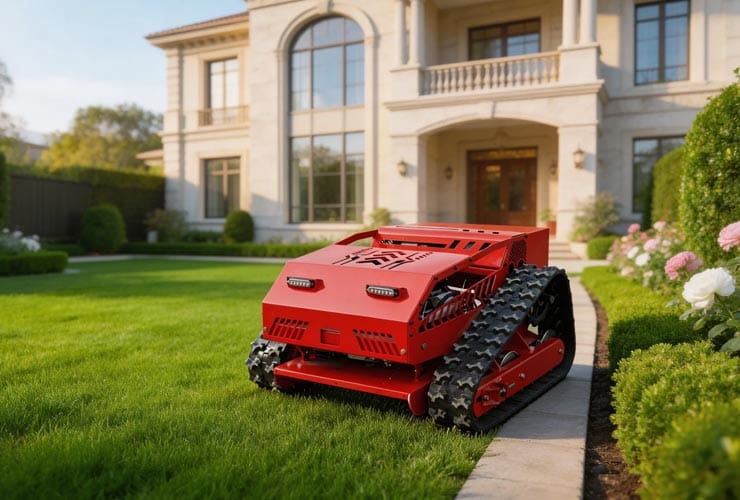
A remote control lawn mower is designed for mowing grass, weeds and light brush in areas where conventional lawn mowers are difficult, inefficient or unsafe to operate.
Unlike a standard ride-on mower, a remote control mower allows the operator to control the machine from a safe position away from the cutting deck. This makes it useful for steep slopes, roadside verges, riverbanks, solar farms, orchards, parks, drainage channels and other difficult terrain.
However, not every remote control lawn mower is designed for the same conditions. Some models are compact and suitable for landscape maintenance, while others use tracked drive systems, diesel engines and heavy-duty cutting decks for dense vegetation and demanding commercial work.
The right machine depends on the terrain, vegetation, slope, working area, required productivity, transport needs and available attachments.
This guide explains what buyers should evaluate before choosing a remote control lawn mower for professional or commercial use.
Table of Contents
What Is a Remote Control Lawn Mower?
A remote control lawn mower is a powered mowing machine operated through a wireless controller rather than from a seat on the machine.
The operator can typically control:
- Forward and reverse travel
- Steering
- Cutting operation
- Travel speed
- Cutting height
- Hydraulic functions
- Attachments
- Emergency stop functions
The operator remains outside the machine’s immediate operating area. This can reduce direct exposure to steep ground, uneven terrain, flying debris, excessive vibration, dust and engine heat.
A remote control lawn mower is not necessarily an autonomous robotic mower. The operator still controls the machine in real time and must continuously observe the terrain, vegetation, people, obstacles and machine behavior.
This distinction is important:
| Remote control lawn mower | Robotic lawn mower |
|---|---|
| Controlled by an operator in real time | Operates according to programmed routes |
| Suitable for rough ground, slopes and dense vegetation | Generally designed for maintained lawns |
| Can respond immediately to rocks, holes and obstacles | Depends on mapping, sensors or boundary systems |
| Often uses stronger cutting systems | Usually designed for routine grass maintenance |
| Requires an operator during mowing | May operate with limited supervision |
A remote mower is usually selected for terrain and vegetation that require active control rather than scheduled lawn maintenance.
Why Are Remote Control Mowers Used on Slopes?
Sloped ground creates several challenges for conventional mowing equipment.
A ride-on mower places the operator directly on the machine while it travels across an incline. On uneven or wet terrain, traction, visibility and stability can become difficult to manage. A walk-behind mower may reduce some risks but can still require the operator to work directly on unstable ground.
A remote control lawn mower allows the operator to stand on a more stable area while controlling the machine from a distance.
Professional remote mower manufacturers commonly promote applications such as:
- Steep embankments
- Highway and roadside vegetation
- Riverbanks and drainage channels
- Solar farms
- Orchards and vineyards
- Parks and public land
- Railway corridors
- Industrial grounds
- Overgrown grass and light brush
For example, SPIDER’s official remote mower application information highlights slopes, fields, solar parks and difficult-to-reach areas. The company also notes that slope capability depends on surface conditions, vegetation, moisture and correct machine use.
This is an important point for every buyer: a stated maximum slope should not be treated as a universal operating recommendation. Wet grass, loose soil, hidden holes, side slopes, heavy attachments and incorrect machine orientation can all affect safe performance.
Tracked or Wheeled Remote Control Lawn Mower?
The drive system has a direct effect on traction, ground pressure, maneuverability and surface impact.
Tracked remote control lawn mower
Tracked models generally provide:
- Greater contact area with the ground
- Better traction on uneven surfaces
- Stable operation on rough terrain
- Lower ground pressure in some configurations
- Improved ability to cross soft or irregular ground
Tracks are often preferred for steep embankments, rough grass, ditches, construction land and uneven agricultural areas.
However, tracks can mark sensitive turf when the machine turns sharply. They may also add weight and require additional maintenance for rollers, sprockets and track tension.
Wheeled remote control lawn mower
Wheeled models may provide:
- Faster travel on firm ground
- Easy maneuverability
- Lower rolling resistance
- Less surface disturbance on suitable turf
- Simpler maintenance in some designs
They can be appropriate for parks, sports grounds, maintained grass and relatively stable fields.
The correct choice depends on the ground rather than the assumption that tracks are always better. For wet, uneven or soft terrain, tracks may provide more usable traction. For flat, maintained areas, wheels may offer efficient travel and reduced turf disturbance.
How to Compare Slope Capability
Slope capability is one of the most important specifications when buying a remote control mower, but it must be understood correctly.
Manufacturers may express slope performance in:
- Degrees
- Percentage gradient
- Front-to-back slope
- Side slope
- Static stability angle
- Working slope
- Slope with or without a winch
These measurements are not interchangeable.
A machine rated for a particular angle under controlled conditions may have a different safe working limit on wet grass, loose soil or dense vegetation. Buyers should ask for the full operating conditions behind the stated slope figure.
Before choosing a machine, confirm:
- Maximum recommended working slope
- Whether the figure applies uphill, downhill and across the slope
- Whether a stabilizing winch is required
- Ground and vegetation conditions used for testing
- Emergency stop behavior
- Automatic braking or anti-roll features
- Operator distance and visibility requirements
The Health and Safety Executive’s excavator and lifting guidance is not specific to every mower model, but it demonstrates the importance of site risk assessment, operator control and safe working procedures for powered equipment.
A responsible supplier should provide a model-specific manual and explain the limitations instead of presenting one maximum angle as suitable for every job.
Cutting System: Rotary, Flail or Mulching Deck?
The cutting system should match the vegetation.
Rotary cutting deck
A rotary deck is generally used for grass, weeds and lighter vegetation. It can offer a clean cut and good productivity when vegetation is regularly maintained.
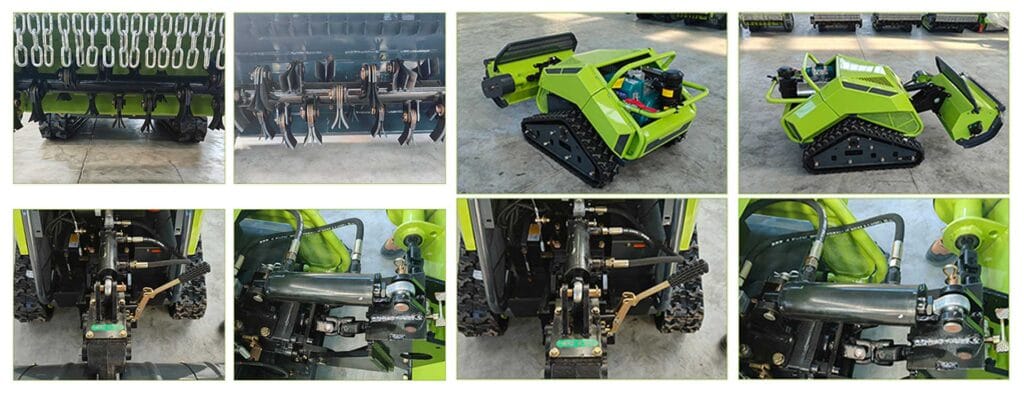
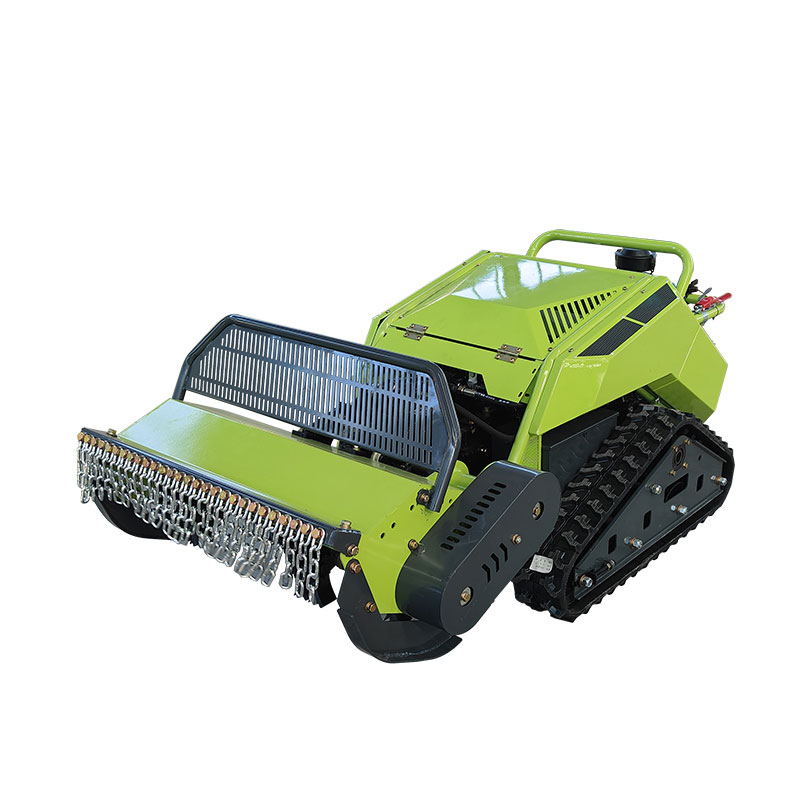
Flail cutting system
A flail mower uses rotating flails or blades to process denser grass, weeds and lighter brush. It may be preferred for:
- Overgrown verges
- Orchard grass
- Rough fields
- Embankments
- Light scrub
- Seasonal vegetation control
Mulching system
A mulching deck cuts vegetation into smaller pieces and distributes the material over the ground. This can reduce the need for collection, but performance depends on vegetation density, moisture, cutting height and machine power.
When comparing a remote control lawn mower, ask:
- What vegetation can the cutting system handle?
- What is the maximum recommended grass height?
- Is the deck suitable for woody stems?
- How are blades or flails replaced?
- Can cutting height be adjusted?
- Is the deck protected from impact?
- Are replacement parts available?
Avoid choosing a mower only by cutting width. A wider deck may increase output on open ground, but a narrower deck may be easier to use between trees, under solar panels or along narrow embankments.
Electric or Diesel Remote Control Lawn Mower?
Power source affects runtime, refueling, noise, maintenance and suitability for different applications.
Electric remote mower
Electric models may be suitable for:
- Noise-sensitive locations
- Indoor or semi-enclosed areas
- Parks and public spaces
- Solar facilities
- Routine grass maintenance
- Low-emission projects
The main factors to compare include battery capacity, charging time, working runtime, replacement battery cost and performance under heavy vegetation.
Diesel remote mower
Diesel models may be suitable for:
- Long working shifts
- Dense grass and brush
- Large commercial sites
- Agricultural land
- Roadside and municipal maintenance
- Applications requiring rapid refueling
A diesel machine may provide longer continuous operation when fuel logistics are easier than battery charging. Buyers should still evaluate engine emissions requirements, noise restrictions, maintenance access and local regulations.
Luyue’s 13kW Diesel Lawn Mower LY-80PROMAX is described as a tracked, remote-controlled mower for photovoltaic parks, orchards, river embankments and other complex terrain. The product page lists an 800 mm cutting width and multiple implement options, including rotary tilling and ditching equipment.
Actual performance will depend on vegetation, terrain, working speed and operator technique. Buyers should request a complete technical sheet for their destination market.
Remote Control Range and Operating Visibility
Remote control range is important, but a longer advertised range does not automatically make a machine safer or more productive.
Actual control performance can be affected by:
- Buildings
- Trees
- Terrain changes
- Power lines
- Other radio equipment
- Weather
- Antenna position
- Battery condition
- Operator visibility
The operator should maintain a clear view of the machine and its working area. A remote mower should not be operated behind an obstruction simply because the controller still receives a signal.
Ask the supplier about:
- Rated line-of-sight control distance
- Emergency stop response
- Loss-of-signal behavior
- Remote battery runtime
- Warning indicators
- Machine-side emergency stop
- Operator training
- Replacement controller availability
A reliable remote control system should fail safely when communication is interrupted. The machine should not continue cutting or traveling without control.
Important Safety Features
Safety equipment should be evaluated before productivity claims.
Look for features such as:
- Emergency stop on the remote
- Emergency stop on the machine
- Automatic stop after signal loss
- Automatic braking on descent
- Protective screens around the cutting deck
- Audible warning signals
- High-visibility markings
- Battery isolation switch
- Low center of gravity
- Stable track or wheel configuration
- Clear operating instructions
The HSE guidance on lifting operations emphasizes that powered equipment operations should be properly planned, supervised and carried out safely. Although mowing is not the same as lifting, the same principle applies: buyers need a documented operating process, trained operators and a site-specific risk assessment.
Before mowing, inspect the area for:
- Rocks
- Wire
- Tree roots
- Holes
- Drainage openings
- Buried objects
- People and animals
- Vehicles
- Water hazards
- Overhead or underground utilities
A remote mower keeps the operator away from the machine, but it does not remove the need for proper site control.
Remote Control Lawn Mower Applications
Solar farm vegetation management
A low-profile remote mower can help maintain grass under and around solar panels where conventional equipment may be difficult to maneuver.
Important considerations include:
- Machine height
- Cutting width
- Turning radius
- Debris control
- Cable and panel protection
- Noise and emissions
- Ground clearance
- Operator visibility
The machine should be tested in the actual panel layout before large-scale deployment.
Roadside and embankment mowing
Roadside vegetation maintenance may involve slopes, traffic, drainage ditches and uneven verges. Remote operation can allow the operator to work from a more controlled position, but traffic management and exclusion zones remain essential.
Orchard and vineyard mowing
Between-row mowing requires a suitable width, turning radius and cutting system. Low-height machines may also be useful beneath branches or around planting rows.
Luyue’s agricultural operations equipment solutions cover machinery applications for farms, uneven ground and seasonal workloads.
Municipal and public-land maintenance
Municipal teams may use remote mowers for:
- Parks
- Drainage channels
- Riverbanks
- Public slopes
- Roadside verges
- Vacant land
- Industrial boundaries
Luyue also provides municipal maintenance equipment solutions for public works and daily maintenance applications.
Landscape contracting
Landscape contractors often need equipment that can move between different properties and handle changing vegetation conditions.
Useful selection factors include:
- Transport size
- Quick setup
- Cutting system flexibility
- Remote control range
- Battery or fuel logistics
- Spare parts support
- Operator training
- Seasonal productivity
Luyue’s landscape contracting solutions can be used as an internal reference when comparing equipment for commercial grounds maintenance.
How to Choose the Right Remote Control Lawn Mower
Before requesting a quotation, prepare the following information.
Terrain
- Maximum slope
- Typical slope direction
- Ground type
- Wet or dry working conditions
- Presence of rocks or obstacles
- Required working area
Vegetation
- Grass height
- Weed density
- Brush diameter
- Moisture level
- Cutting frequency
- Required finish quality
Machine performance
- Cutting width
- Working speed
- Slope capability
- Track or wheel system
- Ground clearance
- Turning radius
- Remote control distance
- Runtime or fuel consumption
Business requirements
- Daily working hours
- Number of operators
- Transport method
- Spare parts requirements
- Local emissions rules
- OEM branding needs
- Expected order quantity
- Dealer or distribution plans
A supplier should recommend a configuration based on the complete application rather than quoting a model based only on its advertised power.
Common Buying Mistakes
Choosing by slope angle alone
Slope figures do not describe every terrain condition. Ask how the figure was tested and whether it applies to actual mowing with the selected deck.
Ignoring the cutting system
A mower designed for short grass may not be suitable for dense weeds or brush. Match the deck to the vegetation.
Forgetting transport dimensions
A machine may perform well but still be difficult to load, store or move between jobsites.
Assuming remote control means autonomous operation
Most remote control lawn mowers require an operator throughout the task. They are not necessarily autonomous robots.
Buying without a spare-parts plan
Blades, belts, flails, tracks, filters and remote batteries may require replacement. Confirm service support before ordering.
Trusting maximum productivity claims without conditions
Productivity depends on terrain, vegetation, working width, speed, operator experience and cutting frequency. Request the conditions behind any output figure.
Why Consider Luyue Remote Control Lawn Mowers?
Luyue supplies compact construction and land-maintenance machinery for international buyers, contractors, dealers and importers.
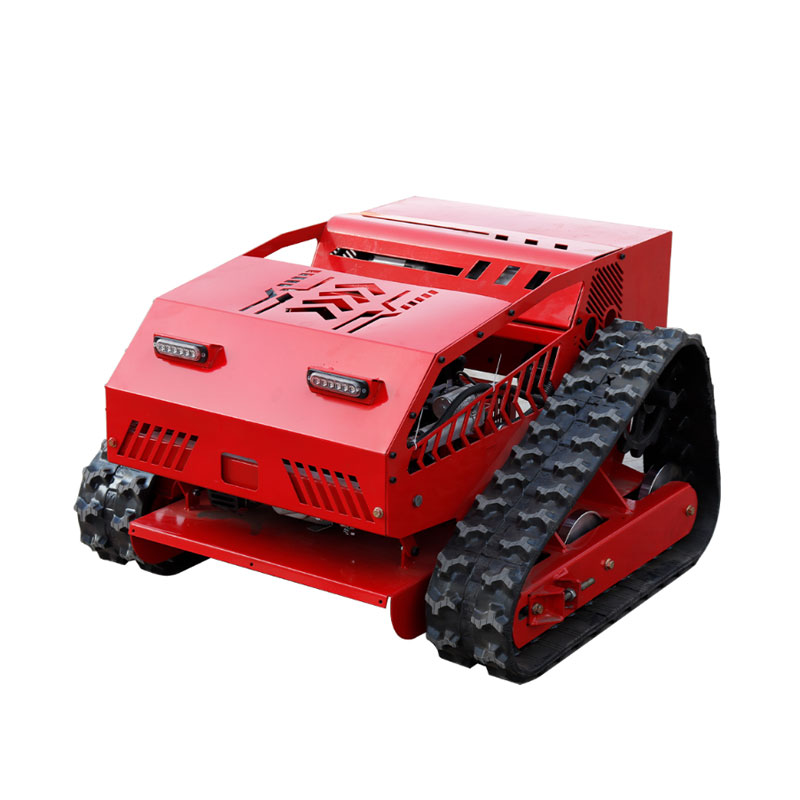
The remote control lawn mower range currently includes tracked mower models and a diesel-powered multifunctional mower.
When contacting Luyue, buyers can provide:
- Application area
- Maximum slope
- Vegetation type
- Required cutting width
- Preferred power source
- Working hours per day
- Required attachments
- Destination country
- OEM or branding requirements
This information helps the team compare suitable mower configurations and explain the available options.
For a model recommendation, contact Luyue Machinery with photos or videos of the terrain, the approximate slope and the type of vegetation that needs to be cut.
FAQ
What is a remote control lawn mower used for?
A remote control lawn mower is used for mowing grass, weeds and light brush on slopes, embankments, solar farms, orchards, riverbanks, parks, roadsides and other difficult terrain.
Is a remote control lawn mower the same as a robotic mower?
No. A remote control mower is actively controlled by an operator. A robotic mower normally follows programmed routes and may use boundary wires, GPS or other navigation systems.
Can a remote control mower work on steep slopes?
Some models are designed for slopes, but the safe working angle depends on surface conditions, moisture, vegetation, machine configuration and operator training. Always follow the model-specific manual.
Are tracked remote mowers better than wheeled models?
Tracks can provide useful traction on uneven, soft or rough terrain. Wheels may be suitable for firm, maintained ground. The best system depends on the application and surface conditions.
What cutting width should a commercial mower have?
The suitable cutting width depends on the available working space, vegetation density and desired productivity. A wider deck covers open ground faster, while a narrower deck is easier to use between trees, panels and obstacles.
How far can a remote control lawn mower operate?
The usable distance depends on the model, terrain, line of sight and radio conditions. Buyers should focus on stable control, emergency-stop behavior and visibility rather than range alone.
What should I send when requesting a quote?
Send the application, slope, vegetation type, approximate area, required cutting width, working hours, destination country, preferred power source and any attachment requirements.
Conclusion
A remote control lawn mower can be a practical solution for maintaining slopes, rough grass, embankments, orchards, solar farms and other areas where conventional mowing equipment is difficult to use.
The right machine should be selected according to:
- Terrain and slope
- Vegetation type
- Cutting system
- Track or wheel configuration
- Power source
- Remote control safety
- Transport dimensions
- Maintenance support
- Required attachments
Do not choose a mower based only on maximum slope, engine power or cutting width. A machine that matches the actual terrain and vegetation will usually provide better operating safety, more consistent productivity and lower long-term risk.
Explore Luyue’s remote control lawn mower products or contact the Luyue team to discuss your working conditions and receive a suitable configuration recommendation.