
Introduction
One of the most common questions we receive from contractors is:
“What size mini crusher do I actually need?”
Many buyers begin by comparing machine prices or looking for the highest possible capacity.
In practice, neither approach is ideal.
A crusher that is too small can slow down the entire job. A machine that is much larger than the project requires can increase purchase cost, transportation requirements, and operating expenses without creating much additional value.
The right crusher should match the amount of material you really need to process.
For most small construction and demolition projects, the decision often comes down to questions such as:
Do I need approximately 3–5 tons per hour?
Should I move up to 5–10 tons per hour?
How many hours will the crusher work each day?
Is the machine used every day or only on certain projects?
How large are the concrete or stone pieces before crushing?
This guide explains how to choose a practical mini mobile crusher based on real workload rather than simply buying the biggest machine available.
Table of Contents
Why Crusher Capacity Should Match Your Real Workload
Start With Tons Per Day, Not Only Tons Per Hour
When a 3–5 T/H Crusher Is Usually Enough
When a 5–10 T/H Crusher Makes More Sense
What If You Need More Than 10 T/H?
Why Feed Size Can Be Just as Important as Capacity
How Working Hours Affect Crusher Selection
LY430 vs LY510: Which One Fits Your Project?
A Practical Contractor Scenario
Common Buying Mistakes
Frequently Asked Questions
Conclusion
Why Crusher Capacity Should Match Your Real Workload
Crusher capacity is usually expressed in tons per hour.
That number is useful, but it should not be considered by itself.
A contractor who processes 15 tons of concrete during an entire day does not necessarily need a 10-ton-per-hour machine.
At the same time, a contractor who needs to clear 50 tons before noon may find a 3–5 T/H crusher too slow.
The first question should therefore be:
How much material do you realistically need to process in a normal working day?
You should also consider how much time will actually be available for crushing.
A construction site rarely runs like a laboratory.
There may be time spent on:
Breaking oversized concrete;
Moving material;
Loading the crusher;
Separating unwanted waste;
Moving the machine around the job site.
For this reason, theoretical hourly capacity and real daily output are not always the same.
Start With Tons Per Day, Not Only Tons Per Hour
When we discuss crusher selection with customers, daily workload often gives a clearer picture than simply asking for the highest hourly capacity.
For example, imagine three contractors.
Contractor A
Processes around 10–15 tons of concrete on some demolition days.
The crusher may only operate for several hours.
A compact machine can often handle this type of workload comfortably.
Contractor B
Regularly processes 30–50 tons of construction waste per day.
The machine is expected to operate for longer periods.
Higher capacity becomes more important.
Contractor C
Needs to process well above 80–100 tons per day.
At this point, a very small mobile crusher may no longer be the right solution.
The customer should consider larger crushing equipment rather than forcing a compact machine to work outside its practical range.
This is why the right equipment recommendation should start with the project, not the product catalogue.
When a 3–5 T/H Crusher Is Usually Enough
A 3–5 T/H mini mobile jaw crusher can be a practical solution for many small contractors.
Typical applications include:
Residential demolition;
House renovation;
Small concrete recycling projects;
Landscaping work;
Municipal maintenance;
Occasional construction waste processing.
The important factor is not that the project is called “small.”
The important factor is whether the required daily output can be completed within a reasonable working period.
For example, if a contractor needs to process approximately 15 tons of prepared material, a 3–5 T/H machine may be sufficient.
This type of crusher is especially attractive when the customer values:
Compact dimensions;
Easier transportation;
Lower investment;
Flexible movement between job sites.
For many first-time crusher buyers, this balance is more useful than simply chasing higher capacity.
When a 5–10 T/H Crusher Makes More Sense
A 5–10 T/H mobile jaw crusher becomes more practical when material volumes increase.
Typical users may include:
Demolition companies with regular projects;
Construction waste recycling businesses;
Equipment rental companies;
Contractors who need faster material processing;
Businesses operating the crusher on a more frequent basis.
If the project regularly produces 30, 40, or more tons of material per day, additional capacity can significantly improve workflow.
Higher production may also be valuable when:
The job site must be cleared quickly;
Several projects are scheduled close together;
Crushing is part of the company’s normal daily operation.
However, this does not mean every customer should automatically choose the higher-capacity machine.
If the equipment spends most of the year unused, the additional investment may not make economic sense.
What If You Need More Than 10 T/H?
This is an important point that equipment suppliers should be clear about.
If your actual requirement is consistently above 10 tons per hour, a 3–5 T/H or 5–10 T/H mini crusher may not be the right solution.
Trying to use an undersized crusher for a high-volume project can result in:
Excessive working hours;
Project delays;
Faster wear;
Frustration for the operator.
In this situation, a larger mobile crusher should be considered.
Not every project should be matched to the smallest available machine.
A good equipment recommendation should also be able to tell a customer when a particular model is not suitable.
Why Feed Size Can Be Just as Important as Capacity
Many first-time buyers focus heavily on tons per hour and overlook feed size.
This can lead to the wrong machine choice.
Imagine two projects that both need to process 20 tons per day.
Project A involves small concrete pieces that have already been broken down.
Project B involves large foundation sections.
Although the daily tonnage is the same, the second project places very different demands on the crusher.
Before choosing equipment, you should know:
Maximum material dimensions;
Typical material size;
Material type;
Whether pre-breaking is required.
A machine with enough theoretical capacity can still be unsuitable if the material does not fit comfortably into the feed opening.
How Working Hours Affect Crusher Selection
Another question we often ask is:
How many hours per day do you want the crusher to operate?
This changes the calculation considerably.
For example:
If you need to process 20 tons and have most of the day available, a 3–5 T/H machine may be sufficient.
If the same 20 tons must be completed very quickly, additional capacity may be justified.
Customers should therefore consider both:
Required daily tonnage + available crushing time
rather than looking at only one number.
LY430 vs LY510: Which One Fits Your Project?
LUYUE offers compact mobile jaw crusher solutions for different workload levels.
The following comparison provides a simple starting point.
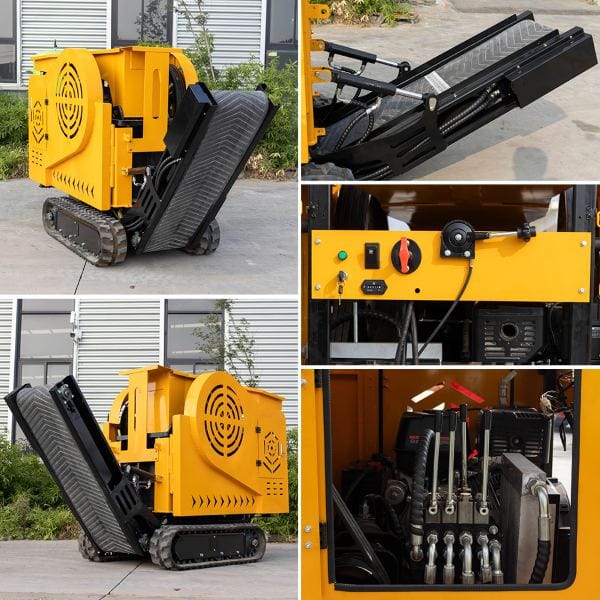
LUYUE LY430 Mini Mobile Jaw Crusher
The LUYUE LY430 Mini Mobile Jaw Crusher is designed for smaller construction, demolition, and recycling projects.
Main specifications:
Feed opening: 220 × 350 mm
Capacity: approximately 3–5 T/H
Weight: approximately 1,850 kg
It is often suitable for customers who:
Handle smaller daily volumes;
Need easy transportation;
Work on multiple small job sites;
Do not require continuous high-output production.
For residential demolition, landscaping, and smaller concrete recycling projects, this type of capacity can provide a practical balance between productivity and investment.
Internal link: Link the anchor text LUYUE LY430 Mini Mobile Jaw Crusher to the LY430 product page.
LUYUE LY510 Mobile Jaw Crusher
The LUYUE LY510 Mobile Jaw Crusher is designed for customers requiring more production capacity.
Main specifications:
Feed opening: 250 × 400 mm
Capacity: approximately 5–10 T/H
Weight: approximately 3,950 kg
Kubota D1105 Stage V or Laidong diesel engine options
It may be more suitable for:
Regular demolition projects;
Construction waste recycling companies;
Higher daily material volumes;
Customers who operate the crusher more frequently.
The higher capacity allows more material to be processed within the same working period.
Internal link: Link the anchor text LUYUE LY510 Mobile Jaw Crusher to the LY510 product page.
A Practical Contractor Scenario
Consider a contractor who regularly handles residential demolition.
The company typically generates around 15–20 tons of concrete and brick waste on a project.
The first instinct may be to buy the largest crusher possible.
But after looking at the actual workload, the contractor may find that crushing is only required for several hours during certain stages of the project.
In this situation, a compact 3–5 T/H crusher may provide enough capacity while remaining easier to transport.
Now consider another company handling construction waste almost every day.
Its projects regularly generate 40 tons or more of material.
For this business, moving to a 5–10 T/H crusher may reduce operating time and help the company complete projects more efficiently.
Both customers need a mobile crusher.
But they do not necessarily need the same mobile crusher.
Common Buying Mistakes
Choosing Only by Price
The cheapest crusher may not have enough capacity for the project.
The result can be longer working hours and lower efficiency.
Choosing Only by Maximum Capacity
Buying excessive capacity can increase investment without increasing actual business value.
Ignoring Feed Size
A crusher may have sufficient hourly capacity but still be unsuitable for oversized material.
Ignoring Transportation
For contractors moving between sites, machine size and weight can be just as important as production.
Planning Only for One Project
Consider realistic future work, but do not oversize equipment based on projects that may never happen.
Frequently Asked Questions
How do I calculate what crusher capacity I need?
Start with your typical daily material volume and the number of hours available for crushing.
Then consider feed size, loading efficiency, material characteristics, and working conditions.
Is 3–5 T/H enough for a small demolition company?
For many residential demolition and small recycling projects, 3–5 T/H can be sufficient.
The final decision depends on daily material volume and available working time.
When should I choose a 5–10 T/H crusher?
A higher-capacity machine is generally more suitable when material is generated regularly, daily volumes are higher, or projects require faster processing.
Should I always buy a larger crusher for future growth?
Not necessarily.
Future business should be considered, but buying significantly more capacity than you can realistically use may increase costs unnecessarily.
What matters more: feed size or hourly capacity?
Both matter.
A crusher cannot work efficiently if the material is too large for its feed opening, regardless of theoretical hourly capacity.
What if I need more than 10 T/H?
If your requirement regularly exceeds 10 T/H, it is better to consider a larger crushing solution rather than forcing a compact crusher to handle a workload it was not designed for.
What information should I send LUYUE before asking for a recommendation?
The most useful information includes:
Material type;
Maximum feed size;
Tons per day or tons per hour;
Expected working hours;
Required output size;
Job-site conditions.
This allows us to recommend equipment based on the actual project rather than making assumptions.
Conclusion
Choosing the right mini crusher is not about buying the highest-capacity machine.
It is about matching equipment to the real workload.
For smaller projects, a 3–5 T/H machine such as the LY430 may provide the flexibility and capacity a contractor actually needs.
For customers processing larger volumes more frequently, the LY510 and its 5–10 T/H capacity may be a more suitable choice.
And when the project requires consistently more than 10 T/H, customers should consider moving to a larger crushing solution.
At LUYUE, we prefer to understand the material, daily workload, feed size, and working conditions before recommending a machine.
The right crusher is not the biggest one. It is the one that allows your project to run efficiently without unnecessary investment.
Internal link: Link mobile crushing solutions here to the LUYUE mobile crusher product category page.