
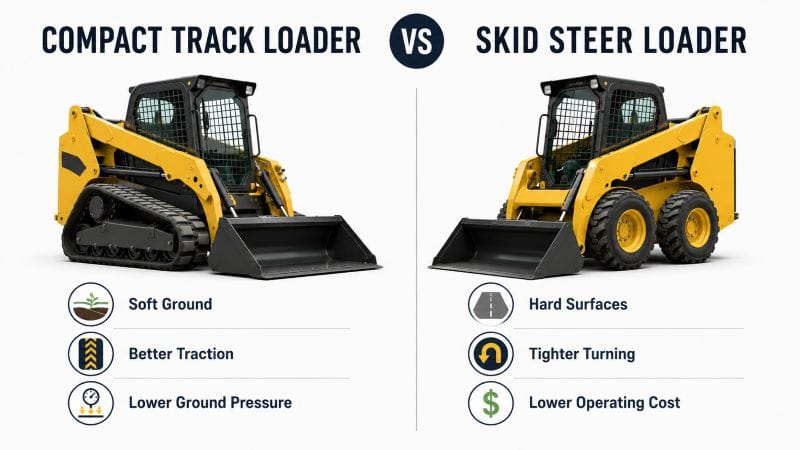
Mini skid steer tracks vs wheels is mainly a jobsite decision: choose tracks for soft, wet, uneven, or surface-sensitive ground; choose wheels for firm surfaces, faster travel, simpler tire service, and lower undercarriage cost. Before ordering, compare the exact machine width, operating load, transport weight, hydraulic flow, attachment interface, and local parts support—not only the undercarriage.
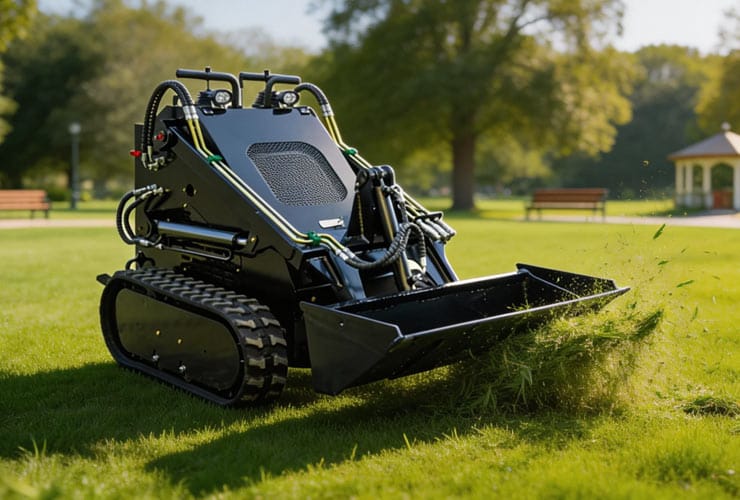
Table of Contents
- Quick comparison
- How tracks and wheels differ
- Best choice by terrain
- Ownership and maintenance
- Specifications to compare
- How to compare Luyue options
- FAQ
Mini Skid Steer Tracks vs Wheels: Quick Comparison
| Decision factor | Tracked mini skid steer | Wheeled mini skid steer |
|---|---|---|
| Soft or wet ground | Usually the better fit because the contact area is larger | More likely to spin or rut when traction is limited |
| Concrete, asphalt, and firm yards | Capable, but tight turns can accelerate track wear | Usually faster and more economical on hard surfaces |
| Finished turf and sensitive soil | Lower ground pressure can reduce sinking, although pivot turns can still disturb turf | Higher point loading can leave ruts in soft conditions |
| Rough or uneven terrain | Longer ground contact generally improves flotation and stability | Best when the surface remains firm and predictable |
| Routine service | Tracks, rollers, idlers, and sprockets require inspection | Tires and wheel components are simpler to inspect and replace |
| Travel and transport | Often heavier and slower; verify the exact data sheet | Often lighter and quicker; verify the exact data sheet |
| Best-fit buyer | Landscaping, utility, agriculture, and site-preparation crews working off-road | Hardscape, warehouse-yard, pavement, and firm-ground contractors |
This mini skid steer tracks vs wheels table is a screening tool, not a substitute for model-specific specifications. A wider or heavier machine may behave differently from a narrower machine in the same undercarriage category.
What Is the Difference Between Tracked and Wheeled Mini Skid Steers?
A tracked mini skid steer spreads its weight along two continuous tracks. A wheeled mini skid steer concentrates the load through four tires. That basic difference changes flotation, traction, turning resistance, travel speed, wear points, and transport weight.
When evaluating mini skid steer tracks vs wheels, do not assume that tracks always protect the surface. Tracks can reduce ground pressure, but an aggressive zero-radius turn can still shear turf. Likewise, wheels are not limited to pavement; suitable tires and dry, compacted soil can make a wheeled machine highly productive.
Which Undercarriage Fits Your Terrain?
Mud, loose soil, sand, and uneven ground
Tracks are normally the stronger starting point where flotation and consistent contact matter. They spread the machine load over a larger footprint and help the loader keep pushing when individual tires would sink or spin. For this mini skid steer tracks vs wheels use case, also ask about track width, ground clearance, machine weight, cleaning access, and the cost of replacement undercarriage parts.
Concrete, asphalt, gravel, and firm yards
Wheels are usually the practical choice when most operating hours are on hard, stable surfaces. They tend to travel faster, turn with less resistance, and avoid the accelerated rubber-track wear caused by frequent pivoting on abrasive ground. Caterpillar’s general tracks-versus-wheels guidance similarly emphasizes traction and low ground pressure for tracks, and lower operating cost and higher travel speed for wheels.
Lawns, landscaping, and finished surfaces
The answer depends on both ground pressure and turning technique. Tracks can float better on soft turf, but repeated counter-rotation can scuff the surface. Wheels concentrate the load more, yet careful three-point turns on firm turf may cause less surface shear. A realistic mini skid steer tracks vs wheels trial should use the actual ground condition, attachment, payload, and turning pattern expected on the job.
Ownership and Maintenance Costs
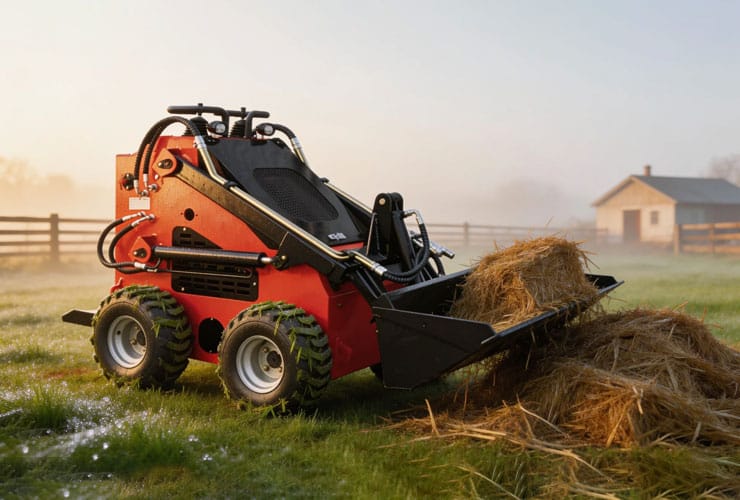
Purchase price is only one part of the mini skid steer tracks vs wheels decision. Track systems add wear components, including tracks, rollers, idlers, and sprockets. Abrasive surfaces, debris packed into the undercarriage, incorrect tension, and sharp pivot turns can shorten service life. A wheeled machine normally has fewer undercarriage components, and a damaged tire may be replaced individually.
Ask each supplier for a written maintenance schedule, wear-part prices, recommended spares, warranty terms, service access instructions, and estimated lead time for parts. Do not compare two quotations unless they cover the same engine, hydraulic package, attachments, shipping terms, and after-sales scope.
Specifications to Compare Before Buying
Use the following checklist to turn a general mini skid steer tracks vs wheels discussion into a model-specific decision:
- Overall width and height: measure gates, alleys, doorways, trailer ramps, and overhead clearance.
- Operating load and lifting geometry: compare the rated figure, lift path, hinge-pin height, dump height, and the attachment actually used.
- Operating and transport weight: include the bucket or attachment, fuel, operator, spare parts, and trailer limits.
- Hydraulic flow and pressure: confirm that every powered attachment falls within the machine and coupler requirements.
- Ground clearance and footprint: evaluate ruts, debris, curbs, and the amount of contact area needed.
- Travel speed and turning space: consider how often the machine moves between work zones.
- Serviceability: check daily inspection points, track tension access, tire availability, filter access, and local technical support.
- Attachment interface: verify mounting dimensions, locking method, hydraulic couplers, mass, and compatibility in writing.
For buyers who change attachments frequently, the best mini skid steer tracks vs wheels choice is the machine that remains stable and within its rated limits with the real attachment—not the one with the most attractive headline specification.
How to Compare Luyue Tracked and Wheeled Options
Luyue lists both a crawler skid steer loader and a mini wheel skid steer loader. Because available engines, attachments, and export configurations can change, request the current model data sheet and quotation before treating any website figure as the final supplied specification.
Send the sales team your ground conditions, minimum access width, normal payload, attachment list, daily travel distance, trailer limits, and destination country. This gives the supplier enough context to answer the mini skid steer tracks vs wheels question for the intended job instead of recommending a machine by category alone.
A Simple Buying Decision
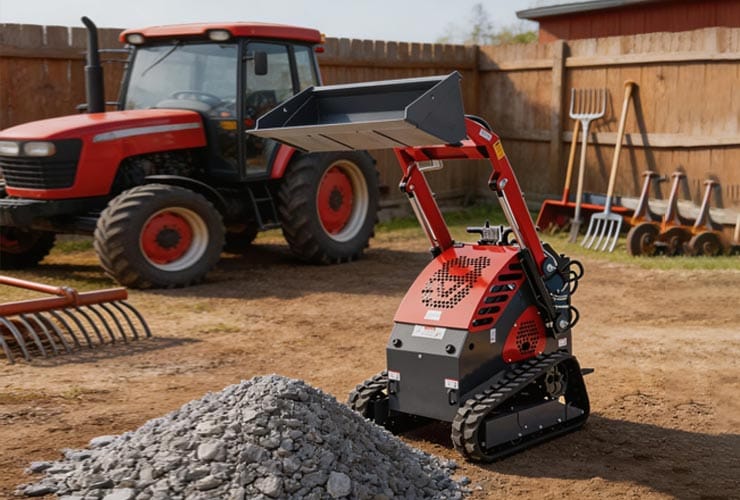
Choose tracks when most hours involve mud, loose soil, uneven terrain, or sites where flotation is essential. Choose wheels when most hours are on concrete, asphalt, compacted gravel, or other firm surfaces and you value faster travel and simpler wear-part replacement.
If the workload is mixed, rank the surfaces by operating hours and by the cost of getting the decision wrong. Losing access on a wet site may cost more than extra undercarriage maintenance; excessive track wear on pavement may erase the traction benefit. That operating profile should decide mini skid steer tracks vs wheels.
Frequently Asked Questions
Mini skid steer tracks vs wheels: what is the short answer?
For mini skid steer tracks vs wheels, start with the surface: tracks suit soft and uneven ground, while wheels suit firm ground and frequent travel. Then verify the exact machine, attachment, load, access, and transport requirements.
Are tracks always better on a mini skid steer?
No. Tracks normally improve traction and flotation on soft or uneven ground, but they add undercarriage wear points and can be costly on abrasive hard surfaces. Wheels are often the better value on firm, dry ground.
Do tracked mini skid steers damage lawns?
They can. Lower ground pressure may reduce sinking, but tight pivot turns can shear turf. Ground moisture, machine weight, tread pattern, payload, and operator technique all affect the result.
Which is cheaper to maintain: tracks or wheels?
Wheels usually have a simpler and less costly wear system, especially on hard surfaces. Actual cost depends on tire or track quality, operating hours, surface abrasiveness, cleaning, tension, and parts availability.
Can the same attachments fit tracked and wheeled mini skid steers?
Possibly, but never assume universal compatibility. Confirm the mounting plate dimensions, locking system, hydraulic flow and pressure, coupler type, attachment weight, and machine rated limits with the supplier.
What information should I send when requesting a quotation?
Provide the job type, terrain, access width, required lift or operating load, attachments, daily travel, transport limits, fuel preference, destination, and required documentation. Ask for the exact configuration and current data sheet in return.
Need help comparing a tracked and wheeled configuration? Contact Luyue Machinery with your jobsite details and request a written, model-specific recommendation.