
If you are considering a small mobile crusher for demolition or construction work, one of the most important questions is: How many tons of concrete can it process in a day?
The answer depends on more than the crusher’s advertised tons-per-hour capacity. Concrete size, hardness, feed method, final output size, operator experience, and effective working hours can all affect actual production.
For small contractors, understanding these factors is more useful than simply choosing the crusher with the highest rated capacity.
How Do You Calculate Daily Crushing Capacity?
A simple starting point is:
Daily production = Actual production rate × Effective crushing hours
For example, if a crusher produces an average of 4 tons per hour and operates effectively for 6 hours:
4 tons/hour × 6 hours = approximately 24 tons/day
However, this does not mean the crusher will continuously crush material for six full hours without interruption.
A real demolition site may also require time for:
Loading concrete into the crusher
Sorting out unsuitable materials
Breaking oversized concrete
Moving the machine around the site
Clearing blockages
Adjusting the working process
Routine inspection and maintenance
Therefore, contractors should calculate production based on effective crushing time, rather than assuming eight hours of continuous maximum production.
How Much Can a Small Mobile Crusher Actually Process?
Different machines are designed for different workloads.
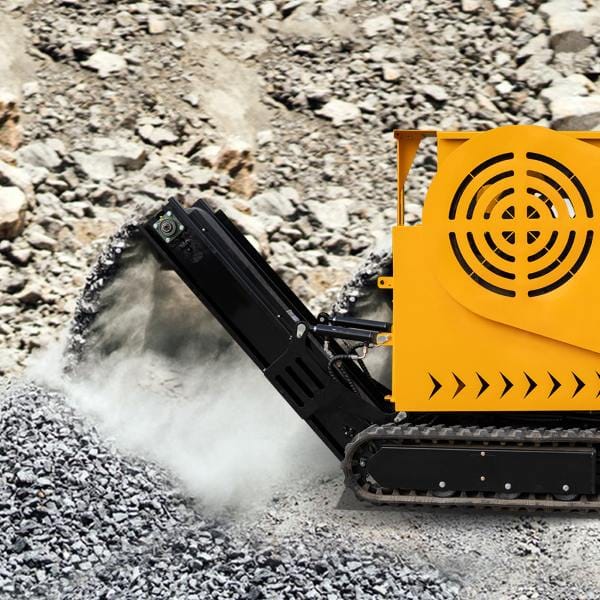
For example, LUYUE’s LY430 small mobile crusher has a production capacity of approximately 3–5 tons per hour, depending on material and operating conditions.
If the machine averages 4 tons per hour and has 5 effective crushing hours during a working day:
4 × 5 = approximately 20 tons per day
For a contractor processing 10–20 tons of concrete during a small demolition or renovation project, this type of compact crusher can provide a practical solution.
For higher workloads, the LY510 mobile crusher offers approximately 5–10 tons per hour under suitable working conditions.
Model Approx. Capacity Typical Application
LY430 3–5 t/h Small demolition, renovation, landscaping and construction projects
LY510 5–10 t/h Higher-volume demolition and construction waste processing
These figures are reference production ranges. Actual output can vary according to material, feed size, final product size, loading method and site conditions.
Why Is Actual Production Usually Lower Than the Maximum Capacity?
A crusher’s maximum capacity should not be treated as its guaranteed daily production.
For example, a machine rated at 5 tons per hour could theoretically produce:
5 × 8 = 40 tons in 8 hours
But a contractor should not automatically expect 40 tons every working day.
If the concrete needs to be sorted, moved, broken into smaller pieces, and loaded manually, the crusher may only have several hours of effective crushing time.
This is particularly important for small demolition projects because the crusher may spend part of the day moving around the site or waiting for material.
A realistic production estimate is therefore more useful when purchasing a machine.
Does the Size of the Concrete Affect Production?
Yes.
Concrete from demolition sites can vary significantly in size.
Small pieces can usually be fed more easily, while oversized concrete may need to be broken before entering a compact crusher.
For example, the LY430 has a feed opening of approximately 220 × 350 mm. This means contractors should consider the size of the concrete produced during demolition and whether additional size reduction will be necessary.
If oversized material must be broken manually before crushing, the overall daily production can decrease.
This is why feed preparation is an important part of crusher productivity.
Does Concrete Hardness Affect Crushing Capacity?
It can.
Concrete is not always the same. Old concrete, high-strength concrete, large aggregate and other hard materials can require different crushing conditions.
Two contractors using the same machine may therefore achieve different production rates.
For this reason, a manufacturer should provide a production range rather than promise one fixed output for every type of concrete.
When asking for a crusher quotation, it is useful to provide information about:
The type of concrete
Typical feed size
Required final size
Estimated daily volume
Expected working hours
The more accurate this information is, the easier it is to recommend a suitable machine.
How Many Tons Per Day Do You Actually Need?
This is often more important than asking how many tons the crusher can process.
For example, imagine a contractor produces approximately 25 tons of concrete waste per day and has around 5 effective crushing hours available.
The required average production rate would be:
25 ÷ 5 = 5 tons per hour
A crusher with an appropriate working capacity around this level could be considered.
If the contractor only produces 10 tons of concrete per day, purchasing a machine designed for much higher production may unnecessarily increase the investment.
On the other hand, if the contractor regularly handles 60–80 tons per day, a very small crusher may not provide enough capacity.
The goal is to match the machine with the normal workload, not the largest workload the contractor may encounter once or twice a year.
Should You Choose a Crusher Based on Its Maximum Capacity?
Not necessarily.
Capacity is important, but it is only one part of the decision.
A contractor should also consider:
Feed Opening
Can the machine accept the typical concrete pieces produced at the demolition site?
Transportability
Can the crusher be moved easily between different projects?
Operating Cost
Does the machine’s fuel consumption make sense for the expected workload?
Final Output
Can the crushed material meet the requirements of the intended application?
Maintenance
Are wear parts and routine maintenance straightforward?
Site Conditions
Is there enough space for feeding, crushing and stockpiling material?
A slightly smaller machine can sometimes be the better choice if it matches the contractor’s normal workload and is easier to transport and operate.
When Is a Small Mobile Crusher a Good Choice?
A small mobile crusher can make sense when a contractor regularly handles relatively modest quantities of concrete and wants to process the material close to where it is generated.
Typical applications include:
Small building demolition
House renovation
Concrete removal
Road maintenance
Landscaping projects
Site preparation
Small construction projects
The biggest advantage is that suitable concrete can potentially be processed on site instead of being transported away as waste.
This can reduce the number of truck trips and allow the contractor to reuse the crushed material for suitable applications such as site access, backfilling or other non-structural work, subject to local requirements.
A Simple Way to Choose Between LY430 and LY510
A useful starting point is to calculate your normal daily concrete volume.
Around 10–20 tons/day: A compact machine such as the LY430 may be worth considering, depending on the material and working conditions.
Around 20–50+ tons/day: A higher-capacity machine such as the LY510 may be more appropriate, depending on the required working hours and material characteristics.
These are not strict limits. The correct model should always be selected according to the actual material, feed size, output requirements and working conditions.
If your daily workload varies significantly between projects, it is also worth considering how many days per month the crusher will actually be used.
What Information Should You Give a Crusher Manufacturer?
If you want an accurate recommendation, provide more than just the question “How many tons per hour can it crush?”
A useful inquiry should include:
Material: Concrete, brick, limestone or mixed construction waste
Feed size: Approximate maximum size of the concrete pieces
Daily volume: How many tons need to be processed
Working hours: Expected effective crushing hours per day
Output: Required final material size
Application: Backfilling, road base, landscaping or another use
With this information, a manufacturer can better determine whether a compact crusher is suitable and which model provides enough capacity without being unnecessarily large.
Final Answer: How Much Concrete Can a Small Mobile Crusher Process in a Day?
There is no single daily production number that applies to every project.
A small mobile crusher may process several tons per hour, but actual daily production depends on the material and the way the machine is operated.
For example, a machine with a 3–5 t/h production range may process roughly 15–25 tons during a day with several effective crushing hours, while a higher-capacity machine in the 5–10 t/h range can handle a larger workload under suitable conditions.
The best way to choose a crusher is therefore to start with your own numbers:
How many tons of concrete do you generate?
How many effective hours can you crush each day?
What feed size do you have?
What final material do you need?
Once these questions are answered, selecting the right small mobile crusher becomes much easier.
For contractors regularly processing demolition concrete, choosing a machine that matches the actual workload can be more valuable than simply buying the machine with the highest advertised capacity.