
Why Smart Production Lines, Precision Processing, and Flexible Manufacturing Systems Matter for Modern Construction Equipment Buyers
In today’s global construction machinery market, buyers are no longer satisfied with basic performance claims or surface-level specifications. As competition intensifies and project margins become tighter, professional equipment buyers increasingly focus on quality stability, consistency across batches, and long-term reliability. These qualities are not determined only by design drawings or component brands. They are primarily shaped by how machines are manufactured. Intelligent manufacturing systems, precision processing technologies, and flexible production lines have become decisive factors behind modern machinery quality.
The term “intelligent manufacturing” is sometimes used loosely in marketing materials, but in professional production environments it has very specific meaning. It refers to the integration of automated equipment, digital process control, precision machining systems, and data-driven quality checkpoints across the production workflow. Instead of relying mainly on manual skill and post-assembly inspection, intelligent factories build quality directly into each production stage. For construction machinery buyers, this shift has measurable consequences.
One of the most visible elements of intelligent manufacturing is precision cutting and forming technology. High-precision laser cutting systems, for example, allow steel plates and structural components to be processed with extremely tight dimensional tolerance. Compared with traditional mechanical cutting, laser systems reduce edge deformation, improve repeatability, and enable complex shapes without secondary correction work. When structural components fit more accurately at the beginning of assembly, downstream welding accuracy and structural alignment improve as well.
Precision at the component level directly influences machine durability. In compact excavators, loaders, and rollers, frame geometry and mounting alignment affect vibration distribution and stress concentration. Small deviations in early fabrication stages can lead to uneven load paths and accelerated wear. Intelligent cutting and positioning systems reduce these deviations, leading to more uniform structural performance across machines produced in different batches.
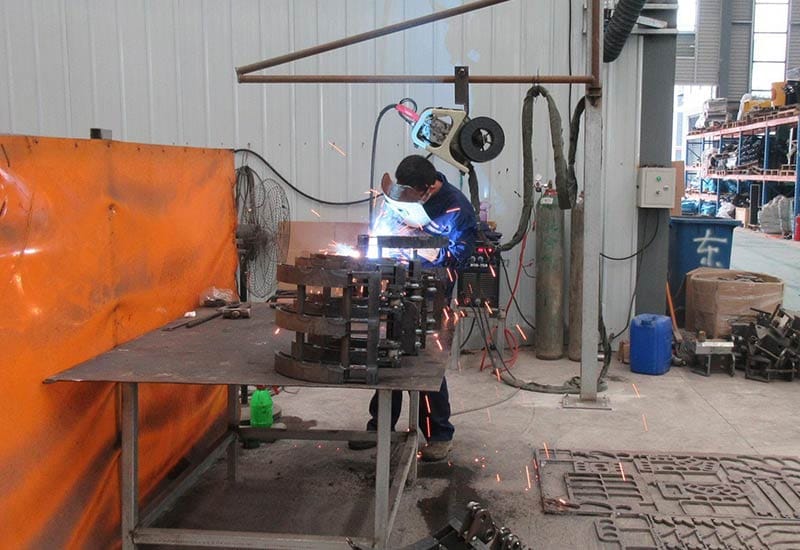
Automated welding systems are another major contributor to quality consistency. While skilled manual welding remains valuable, robotic or guided welding platforms provide repeatable weld depth, speed, and pattern control. In structural machinery components — such as booms, arms, and chassis frames — weld consistency is critical for fatigue resistance. Intelligent welding setups often include programmed weld paths and monitored heat input, reducing the variability that can occur with purely manual processes.
Digital process control extends beyond fabrication into machining and finishing stages. CNC machining centers with programmable tool paths ensure that precision parts — such as pin bores, joint housings, and hydraulic interfaces — meet strict tolerance requirements. Accurate machining improves fit between moving components, which reduces premature wear and improves operational smoothness. For buyers, this translates into longer service intervals and more predictable performance.
Flexible manufacturing systems represent another important evolution in modern machinery production. Traditional production lines are optimized for large volumes of identical products. However, today’s equipment market increasingly demands customization — different configurations, attachment interfaces, climate packages, and branding requirements. Flexible lines use modular tooling, programmable setups, and quick-change fixtures to switch between variants efficiently. This allows factories to handle customized orders without sacrificing production discipline.
From a buyer’s perspective, flexible manufacturing supports practical customization rather than superficial modification. For example, adding auxiliary hydraulic lines, special filtration systems, cold-start packages, or reinforced guarding requires coordinated engineering and process control. Factories with flexible systems can integrate these changes within standard workflows instead of treating them as disruptive exceptions. This improves both delivery speed and quality reliability for customized machines.
Material handling and internal logistics inside the factory also influence final product quality. Intelligent factories often use structured material zoning, barcode or digital tracking, and staged kitting systems. Components are grouped and delivered to assembly stations in organized sets, reducing the chance of incorrect part usage or omission. Traceability systems allow production teams to track which component batches are used in each machine. This traceability is increasingly valued by international buyers who expect accountability and documentation support.
Quality control philosophy has also evolved alongside intelligent manufacturing. Instead of relying only on final inspection, modern factories distribute quality checkpoints throughout the production process. Incoming material inspection, in-process verification, torque confirmation, hydraulic pressure testing, and functional testing are integrated into workflow steps. Problems are detected earlier, when correction is easier and less costly. For buyers, this reduces the probability of hidden defects reaching delivery stage.
Testing systems have become more standardized and instrumented. Functional test benches simulate real operating conditions for hydraulic systems, drive systems, and control responses. Sensors record pressure, temperature, vibration, and response time data. This quantitative testing approach is more reliable than purely visual checks. It also creates records that can be shared with buyers or third-party inspectors as proof of performance verification.
Intelligent assembly guidance is another growing practice. Digital work instructions displayed at assembly stations ensure that operators follow standardized procedures. Torque values, sequence steps, and inspection points are clearly defined. This reduces variability caused by memory-based assembly and improves training speed for new workers. For growing factories, standardized digital instructions help maintain quality while expanding workforce size.
Data collection across production stages enables continuous improvement. Intelligent factories analyze defect patterns, rework frequency, and process deviation data to refine procedures. Instead of reacting only to major failures, they adjust process parameters proactively. Over time, this leads to measurable improvements in consistency. Buyers benefit from more stable product generations and fewer recurring issues.
Surface treatment and coating processes have also improved with automation and environmental control. Controlled blasting, cleaning, and coating lines produce more uniform surface preparation and paint thickness. Better coating quality improves corrosion resistance and visual durability, which is especially important for machines operating in harsh outdoor environments. For export equipment, coating reliability contributes to long-term brand perception in destination markets.
Supplier integration is another dimension of intelligent manufacturing. Advanced factories work closely with component suppliers to standardize specifications and quality expectations. Incoming components are verified against defined criteria rather than accepted passively. Some factories implement supplier rating systems and long-term cooperation frameworks. This upstream discipline reduces variability entering the production line.
For international buyers, intelligent manufacturing also improves order transparency. Digitally managed production schedules allow more accurate delivery forecasts. Progress tracking systems make it easier to provide order status updates. This visibility supports better logistics planning for importers and distributors.
Safety and ergonomics inside intelligent factories indirectly affect product quality as well. Organized layouts, assisted lifting systems, and guided tooling reduce operator fatigue and error rates. When workers can perform tasks safely and comfortably, consistency improves. Professional buyers increasingly recognize that factory working conditions are not only ethical considerations but also quality indicators.
Training systems are often integrated into intelligent manufacturing environments. Simulation tools, guided practice stations, and certification steps ensure that operators understand process requirements before working on production units. Structured training reduces variability across shifts and teams. For buyers, this contributes to batch-to-batch consistency.
Environmental control inside production facilities also matters. Temperature and humidity influence coating, sealing, and some assembly tolerances. Controlled environments reduce variation caused by seasonal changes. While not all factories operate full climate control, higher-end facilities increasingly manage critical zones carefully.
Documentation capability is another benefit of intelligent systems. Digital records of inspections, torque checks, test results, and component batches can be stored and retrieved. This documentation supports warranty analysis and technical support investigations. Buyers value suppliers who can provide traceable production records when questions arise.
It is important to note that intelligent manufacturing does not eliminate human expertise. Instead, it amplifies skilled work with better tools and clearer process control. Experienced engineers and technicians remain essential for process design, quality analysis, and continuous improvement. The best factories combine human expertise with intelligent systems rather than replacing one with the other.
For machinery buyers, evaluating manufacturing capability should be part of supplier selection. Factory audit reports, production line videos, equipment lists, and process descriptions provide useful signals. Buyers who understand production technology can better interpret these signals and make more informed partnership decisions.
As compact and mid-sized construction machinery markets continue to grow, manufacturing quality consistency will become an even stronger differentiator. Design innovation can be copied relatively quickly, but disciplined intelligent manufacturing systems are harder to replicate. Suppliers who invest in precision processing, flexible production, and process transparency build long-term competitive advantage.
For distributors and importers building their own brands through OEM cooperation, choosing partners with intelligent manufacturing capability is especially important. Brand reputation in local markets depends on consistent product performance across shipments. Intelligent production systems provide the stability needed to support that reputation.
In the coming years, intelligent manufacturing will continue evolving through deeper digital integration, predictive quality analytics, and higher automation levels. Buyers who understand how these systems influence product quality will be better equipped to evaluate suppliers and select reliable long-term partners.