If you are searching for a small rock crusher for sale, the biggest mistake is starting with price.
Start with the material.
A crusher that works well for 150 mm limestone is not automatically the right choice for irregular demolition concrete. A machine that produces 5 tons per hour in a controlled test may produce considerably less on a real jobsite if the excavator cannot keep it fed, oversized pieces need to be broken first, or steel and other waste have to be removed.
For contractors, landscapers, demolition companies and small recycling businesses, a compact jaw crusher can be a very useful machine. But it only makes financial sense when the crusher matches the material, workload and way the job is actually carried out.
This guide explains what we recommend checking before buying one.
Quick Answer: What Should You Look for in a Small Rock Crusher?
For most small construction and recycling jobs, look at these five things before comparing prices:
Maximum feed size
Realistic production requirement
Material hardness and condition
Machine transport size and weight
Availability of wear parts and service
A compact tracked jaw crusher in the 2–5 t/h class can be suitable for smaller or intermittent jobs. A 5–10 t/h machine makes more sense when crushing is a regular part of the business and the loading equipment can provide material continuously.
The advertised tons per hour should never be the only reason to choose a crusher.
What Does “Small Rock Crusher” Actually Mean?
This term causes more confusion than many buyers expect.
Search online for a small rock crusher and you may find everything from a laboratory crusher small enough to sit on a bench to a multi-ton tracked machine designed for demolition sites.
They are not intended for the same work.
Laboratory or tabletop jaw crushers
These are mainly used for:
Sample preparation
Mining tests
Geological work
Very small quantities of rock
They may be perfectly good machines for those purposes, but they are not designed to process piles of demolition concrete on a construction site.
Portable or trailer-mounted crushers
These are easier to transport and can work well where the crusher is moved between jobs but does not need to travel around the site frequently.
Tracked compact jaw crushers
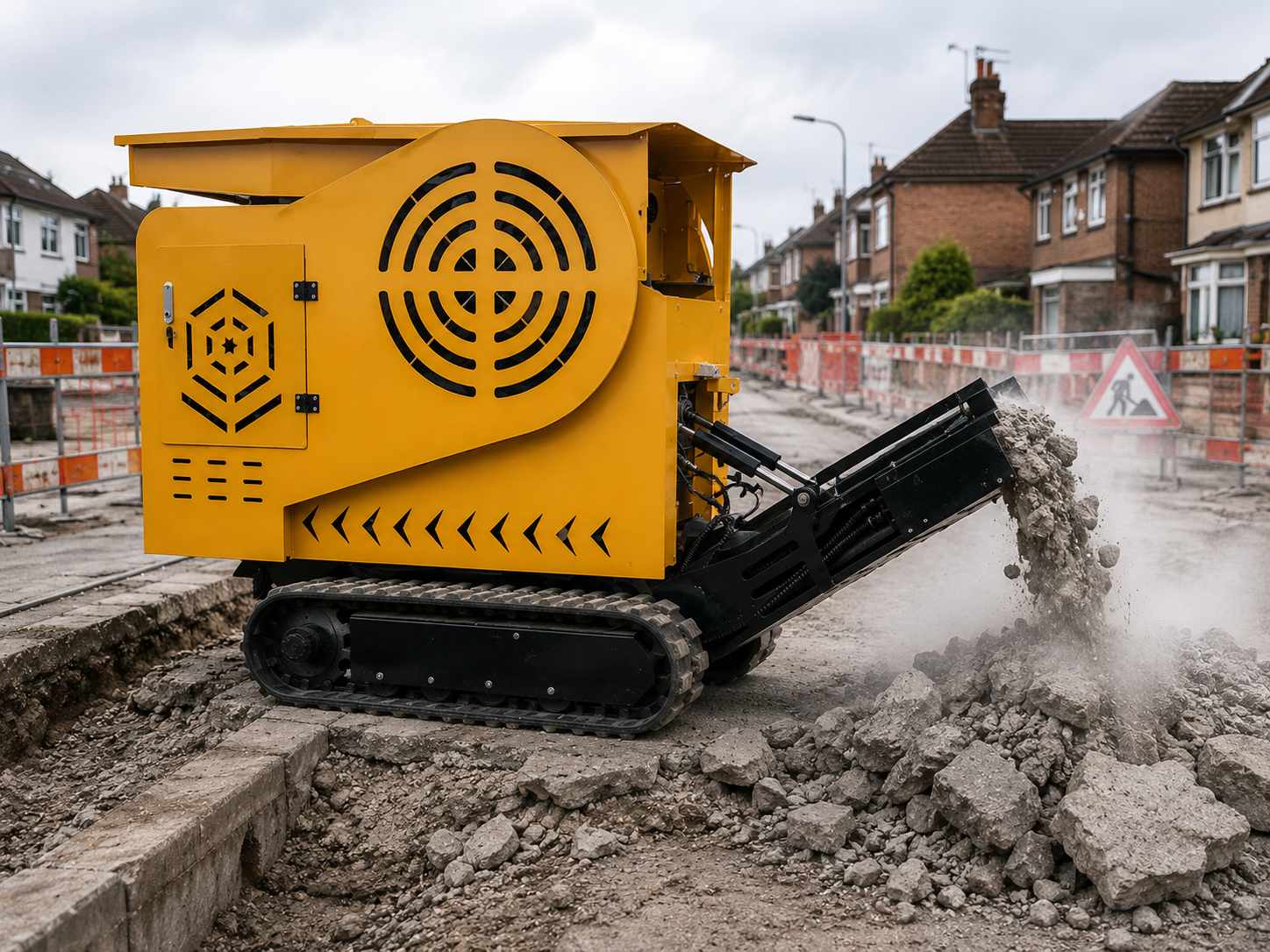
Tracked machines are designed for jobs where the crusher needs to move closer to the material.
This is particularly useful for:
Small demolition projects
Concrete recycling
Road repair
Landscaping
Farm and property work
Construction waste processing
Small aggregate operations
If you are a contractor rather than a laboratory or mining sample user, this distinction should be made before you compare prices.
What Materials Can a Small Jaw Crusher Process?
Jaw crushers are commonly used for hard mineral materials.
Depending on the machine configuration and material condition, typical applications can include:
Concrete
Brick
Limestone
Gravel
Natural stone
Demolition material
Some medium-hard rock
But “construction waste” does not mean everything from a demolition site can be placed into the crusher.
Wood, plastic, insulation, long steel bars and other unsuitable materials should be sorted before crushing.
This sounds obvious, but it has a large effect on actual production.
We sometimes receive enquiries where a buyer asks for a 5-ton-per-hour crusher but the material shown in the photos is a mixed pile of concrete, timber, soil and steel.
In that situation, the crusher is not really the bottleneck.
Material preparation is.
Feed Size Is More Important Than Many Buyers Realize
Consider two customers who both need to crush 10 tons of concrete.
Customer A has concrete pieces around 100–150 mm.
Customer B has half-meter sections of foundation and thick irregular slabs.
The total tonnage is the same.
The job is not.
Customer B first needs to reduce the concrete to a size that can enter the crusher. That may require an excavator and hydraulic breaker before crushing begins.
This is why the dimensions of the crusher inlet matter.
For example:
The LUYUE LY-430 Crawler Jaw Crusher has a feed opening of 220 × 350 mm, with a recommended maximum feed size of approximately 200 mm.
The LUYUE LY510 Crawler Jaw Crusher has a larger 250 × 400 mm inlet, with a listed maximum feed size of 230 × 380 mm.
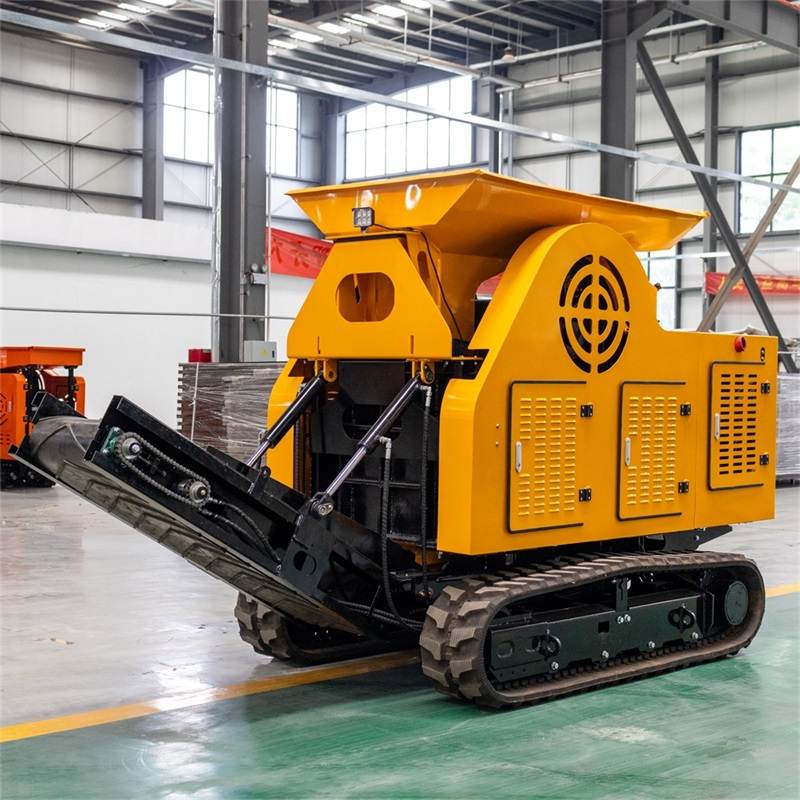
A wider inlet can make feeding easier, but even a larger compact crusher is not intended to accept an entire concrete slab.
Before asking for a quotation, measure the material you normally encounter.
That one measurement can prevent buying the wrong machine.
Why Real Crusher Output Is Different From Advertised Capacity
One of the most common questions we receive is:
“How many tons can this crusher produce in one hour?”
It is an important question, but the answer requires context.
For example, the LY-430 is rated at approximately 2–5 t/h, while the LY510 is rated at approximately 5–10 t/h.
That does not mean every LY510 will produce exactly 10 tons every hour on every material.
Real production depends on several factors.
Feed size
Smaller, consistently sized material usually feeds more smoothly than large irregular pieces.
Material hardness
Limestone and hard natural stone do not behave exactly the same inside the crusher.
Required output size
Reducing material more aggressively normally affects throughput.
Feeding method
A crusher that waits several minutes between each bucket cannot achieve the same daily output as one receiving a steady feed.
Contamination
Soil, timber, steel and mixed debris can slow the complete operation.
Operator experience
Good feeding is important. Overfilling a small jaw crusher does not necessarily increase output.
This is why we prefer to know the customer’s daily workload, not only the theoretical tons-per-hour target.
Small Crusher or Bigger Crusher: Which One Actually Makes More Money?
A larger machine is not always a better investment.
Imagine a contractor who produces only 10–15 tons of waste concrete on a typical project.
Buying a crusher capable of producing 50 tons per hour may sound impressive, but most of that capacity will never be used.
The contractor still has to:
Transport the crusher
Load the material
Prepare oversized concrete
Pay for fuel
Maintain the machine
Store the equipment between jobs
For this type of business, a smaller crusher may take longer to finish each pile but could still produce a better return on investment.
Now consider a contractor who has an excavator feeding concrete continuously every week.
For this customer, using a machine that is too small can create another problem: the excavator and operator spend too much time waiting for the crusher.
In that situation, paying more for higher capacity can be economically reasonable.
The correct capacity is therefore not:
“The biggest crusher I can afford.”
It is:
“The smallest crusher that can complete my normal work efficiently.”
LY-430 vs LY510: Which Compact Crusher Fits the Job?
For buyers looking at small tracked jaw crushers, these two models serve different workloads.
Specification LY-430 LY510
Crusher type Tracked jaw crusher Tracked jaw crusher
Feed opening 220 × 350 mm 250 × 400 mm
Maximum feed size Approx. 200 mm 230 × 380 mm
Production capacity Approx. 2–5 t/h Approx. 5–10 t/h
Transport size 2100 × 1000 × 1750 mm 2750 × 1450 × 2050 mm
Typical application Smaller and intermittent crushing jobs More regular contractor use
Choose the LY-430 when:
You want the more compact machine.
Your jobs normally involve relatively small quantities of concrete, brick or stone.
Access and transport dimensions matter more than maximum production.
Crushing is useful to your business, but it is not an all-day, every-day operation.
See the LY-430 Crawler Jaw Crusher specifications.
Consider the LY510 when:
You regularly process larger piles.
You have equipment capable of maintaining a steady feed.
Finishing the crushing work faster has a real economic value.
You still need a compact tracked machine rather than a large crushing plant.
See the LY510 Crawler Jaw Crusher specifications.
The correct choice should still be based on actual material.
A short jobsite video is often more useful to us than a long list of specifications.
Tracked Crusher or Trailer Crusher?
Both designs have their place.
A trailer-mounted crusher may be a good choice if the machine is delivered to a relatively flat working area, positioned once and left there for the job.
A crawler crusher becomes more attractive when:
The working surface is uneven
The material pile moves during the project
The crusher needs to follow an excavator
Access is restricted
The site has mud or loose ground
The machine needs to reposition without a towing vehicle
For demolition and construction recycling, being able to move the crusher closer to the waste can sometimes save more time than a small increase in theoretical crushing capacity.
Can a Small Rock Crusher Process Concrete?
Yes, provided the concrete is within the appropriate feed size and has been properly prepared.
Concrete is one of the most common materials processed by compact jaw crushers.
However, there is an important difference between clean concrete and heavily reinforced demolition material.
If long reinforcing steel is exposed from the concrete, it should be removed or cut where practical before feeding.
The jaw crusher is designed to crush mineral material.
It is not a steel shredder.
This is especially important on small machines because a long piece of reinforcement can interfere with feeding or material discharge.
If your project involves reinforced concrete, send a photo before buying.
Do not simply tell the supplier that the material is “concrete.”
Can a Small Crusher Handle Granite and Hard Rock?
Potentially, but this is a situation where the supplier should know exactly what material is being processed.
Hard natural rock places different loads on wear parts and the crushing system than recycled brick or relatively softer stone.
If your main material is granite, basalt or another hard rock, provide:
Rock type
Maximum feed size
Required output size
Tons per hour required
Expected daily working hours
Do not choose a crusher simply because an advertisement says “rock crusher.”
The words are broad.
The actual rock is what matters.
How Much Does a Small Rock Crusher Cost?
There is no useful single price for every small rock crusher because machines sold under this name vary enormously.
A small electric laboratory crusher, a trailer-mounted diesel crusher and a multi-ton tracked jaw crusher are three different products.
When comparing quotations, check whether the price includes the same things.
For an imported mobile crusher, look at:
Machine configuration
Engine
Crusher chamber size
Track or trailer system
Conveyor
Spare wear parts
Certification
Packing
Freight
Insurance
Import taxes
Customs clearance
Delivery to your location
A lower FOB price can become a higher total cost after shipping and import expenses are added.
For international buyers, the number worth comparing is usually the landed cost, not just the factory price.
FOB, CIF or DDP: Why the Quotation Term Matters
This is another source of confusion when comparing crusher prices.
FOB
The seller arranges the machine to the agreed export port under the FOB terms of the quotation. The buyer normally arranges the main international transport and destination-side costs.
CIF
The quotation includes the cost of the goods, ocean freight and insurance to the named destination port.
DDP
Where available and clearly quoted, DDP is intended to provide a much more complete delivered price to the agreed destination.
Always read exactly what is included.
Two suppliers can appear thousands of dollars apart simply because they are quoting different delivery terms.
Do the Payback Calculation Before You Buy
For a contractor, the strongest reason to own a small crusher is usually not that crushing equipment is interesting.
It is that waste concrete is already costing money.
Look at your last 12 months of jobs.
Calculate what you spent on:
Waste containers or skips
Truck transport
Disposal or recycling fees
Loading time
Purchased fill or aggregate
Repeated material handling
Then calculate what would realistically change if some suitable concrete could be processed and reused on site.
A basic estimate is:
Annual disposal and replacement aggregate savings
− fuel
− maintenance
− wear parts
= approximate annual operating benefit
Then compare this with the total delivered cost of the crusher.
This calculation does not need to be perfect.
It just needs to be realistic.
If you spend very little each year removing concrete, buying a crusher may not make sense.
We would rather tell a customer that than sell a machine that sits unused.
If concrete removal is a regular and substantial cost, the calculation can look very different.
When You Should NOT Buy a Small Crusher
This is an important part of choosing equipment.
A small mobile crusher may not be right for you if:
You only have one very small crushing job
Almost all material is heavily contaminated
The concrete is much larger than your available pre-breaking equipment can handle
Your required production is far above compact-crusher capacity
You have nowhere useful to reuse or store the crushed material
Local disposal is inexpensive and crushing would add more cost than it saves
You need highly controlled finished aggregate but have no screening system
In these situations, renting a crusher, hiring a crushing contractor or using a larger processing plant may be more sensible.
A crusher should solve a cost or workflow problem.
It should not create another one.
New or Used Small Rock Crusher?
Used equipment can make sense, especially when the purchase price is significantly lower.
But a crusher is a wear machine.
That makes inspection important.
Before buying used, check:
Jaw plate condition
Bearings
Crusher chamber
Hydraulic leakage
Conveyor belt
Tracks
Engine hours
Engine service history
Frame repairs or welding
Electrical components
Availability of replacement parts
A low purchase price loses its advantage very quickly if the crusher needs major repairs immediately after delivery.
For an imported used machine, also consider how easily parts can be identified and shipped.
Spare Parts Matter More Than Buyers Think
Jaw plates are wear parts.
So are conveyor components and other items that operate in abrasive material.
Before choosing a supplier, ask:
Can I buy replacement jaw plates locally?
If not, how quickly can the supplier ship them?
Which wear parts come with the machine?
Are the components standard or custom?
A crusher that stops for three weeks because of a small unavailable component can cost more than the money saved on the original purchase price.
For contractors, uptime is part of the machine price.
What Size Excavator Do You Need With a Small Crusher?
There is no single excavator size for every compact crusher.
What matters is whether the excavator can:
Safely reach the hopper
Handle the typical material
Control the feed rate
Break oversized pieces if equipped appropriately
Work comfortably around the crusher
A very large bucket can actually make feeding a small crusher awkward.
The loading machine and crusher should work as a system.
If possible, tell the crusher supplier which excavator or loader you already own.
That helps determine whether the complete setup will work efficiently.
What Should You Send a Supplier Before Asking for the Final Price?
A supplier can give you a number without knowing anything about your project.
That does not mean it is the right quotation.
For an accurate recommendation, send:
- A photo or short video of the material
This is usually the most useful information.
- Maximum material size
Use approximate dimensions if exact measurements are unavailable.
- Estimated quantity
Tons per day, tons per week or tons per project.
- Desired finished size
For example, whether the material is only being reduced for disposal or reused as fill/base.
- Your loading equipment
Excavator, skid steer, loader or manual loading.
- Country and delivery location
This is needed to calculate realistic transport costs.
With this information, a supplier can recommend a machine instead of simply sending a price list.
Questions to Ask Before Paying a Deposit
Before ordering any small jaw crusher for sale, ask the supplier:
What is the recommended maximum feed size?
What output is realistic for my exact material?
What finished size can the machine produce?
What is the transport width?
What is the complete machine weight?
What engine is fitted?
How is the crusher moved around the jobsite?
What wear parts are included?
How quickly can replacement parts be shipped?
What warranty is provided?
Can I see the machine crushing material similar to mine?
Can the supplier provide a video inspection before shipment?
What exactly is included in the FOB, CIF or DDP quotation?
If the answers are vague before the sale, after-sales communication is unlikely to become easier.
Small Rock Crusher for Sale: The Final Buying Rule
There are hundreds of machines online described as a:
small rock crusher
mini jaw crusher
portable crusher
compact concrete crusher
or
small mobile crusher
The name is less important than the job.
Before choosing one, answer five questions:
What are you crushing?
How large is it before crushing?
How many tons do you actually need to process?
How will you feed the machine?
What will you do with the finished material?
Once these questions are clear, crusher selection becomes much easier.
For smaller, intermittent construction and recycling jobs, a compact model such as the LY-430 may be enough.
For contractors processing material more regularly and requiring higher throughput, the LY510 provides a larger inlet and higher rated capacity while retaining crawler mobility.
The best small rock crusher is not necessarily the cheapest machine or the machine with the highest advertised capacity.
It is the machine that fits the work you already have.
Frequently Asked Questions
What is the best small rock crusher for concrete and stone?
For small construction and recycling work, a compact jaw crusher is often a practical choice because it can process concrete, brick and suitable stone using a relatively simple crushing system. The correct size depends on feed dimensions and required production.
How many tons per hour can a small jaw crusher produce?
Small crusher capacities vary widely. The LY-430 is rated at approximately 2–5 t/h, while the LY510 is rated at approximately 5–10 t/h. Actual output depends on material, feed size, output setting and feeding efficiency.
Is a tracked rock crusher worth buying?
A tracked crusher can be valuable when jobs require frequent repositioning, restricted access or operation on uneven construction sites. If the machine will remain in one fixed position, crawler mobility may be less important.
Can I crush demolition concrete on site?
Yes, if local rules allow it and the material is suitable. Concrete should be prepared to the correct feed size and unsuitable contaminants should be removed before crushing.
Should I buy a crusher or rent one?
If crushing is only required for one or two occasional projects, renting may be more economical. If disposal and aggregate replacement are recurring annual costs, ownership becomes more worth evaluating.
What information do I need to get a crusher quote?
Send the material type, photos or video, maximum feed size, approximate daily quantity, required finished size and delivery location. This gives the supplier enough information to recommend a suitable model.